

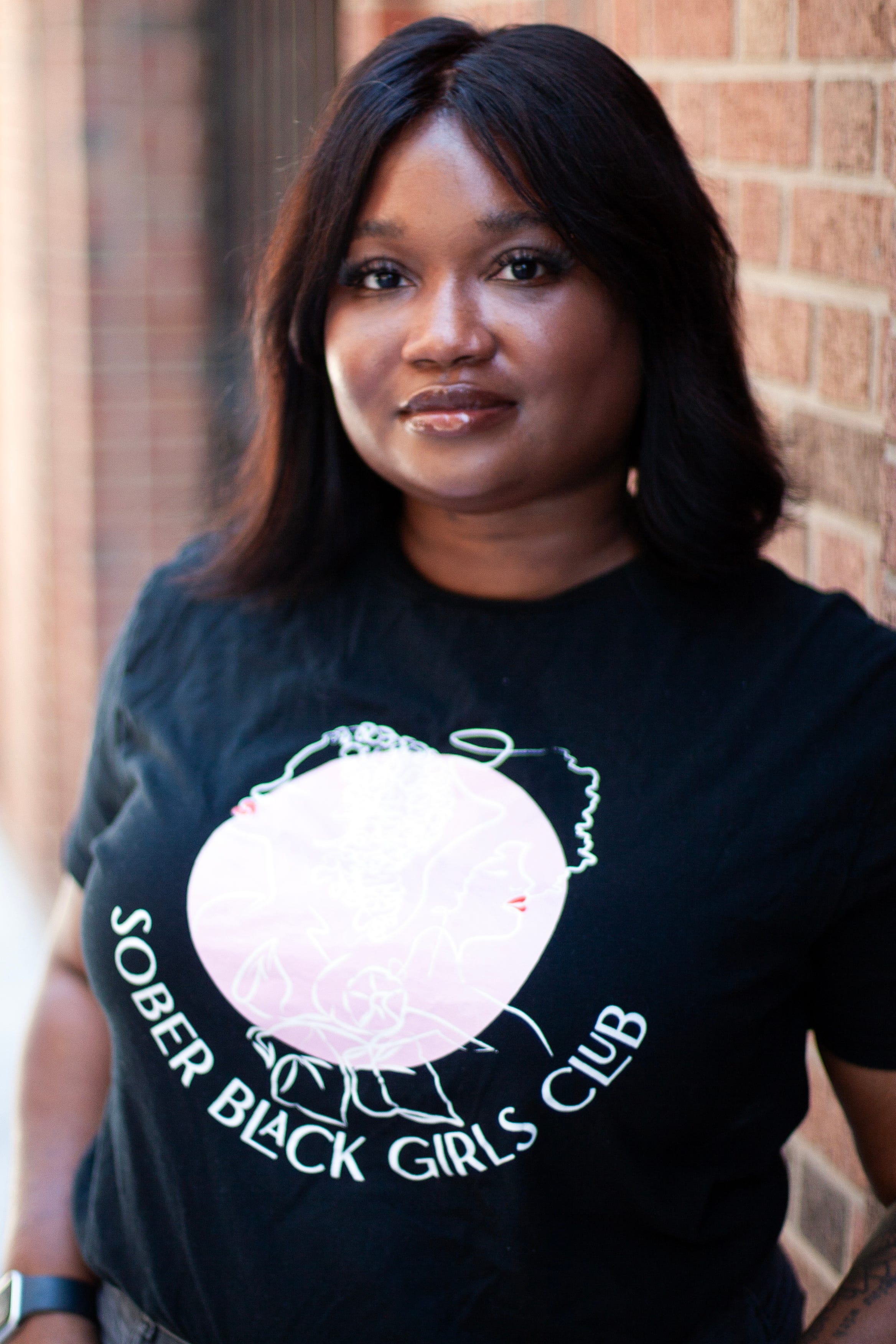
Khadijat A. Oluwatoyin began her sobriety journey in 2018, but she found that many online and in-person options didn’t cater to girls who looked like her or who had similar cultural and societal experiences.
To share her journey and connect with other Black folks practicing sobriety or curious about it, Oluwatoyin created the Sober Black Girls Club. What began as a blog is now a national 501(c)3 collective that provides weekly support meetings, in-person events, an annual fall retreat, and more.
I loved chatting with Khadijat, and I hope you enjoy reading what she has to say.
Katie: Thank you so much for doing this, Khadijat. Can you tell me a little about your early experiences with alcohol?
Khadijat A. Oluwatoyin: My dad and brothers dropped me off at college, and later that night, I had my first drink. I immediately felt relief from the weight of the world and realized it might taste nasty, but it’s like a magic potion. Now I can see that my relationship with alcohol was always unhealthy because, from that moment on, I used it as a release.
At first, I only went out on the weekends, but I don’t remember a time when alcohol was ever social for me. It was always something I used to help me not be here—not be present. At the time, I really needed that. I wanted it. I enjoyed it. I basically spent my college years and law school years drinking. I guess you can say socially; it wasn’t every day or even every weekend. When I did drink, though, I had this weird relationship with it that was different from everyone else. It wasn’t normal. I guess I could say I was drinking socially because I was drinking with other people, but my relationship to it wasn’t social.
KM: I was the same way. I started drinking earlier than you did, but I immediately had the same relationship with it. It was never social. Like, technically, we’re at a party, but I’m here for one thing: getting drunk, not hanging out with people.
KAO: Yeah, exactly. And my parents are Muslim. I’m really religious. I didn’t grow up surrounded by alcohol. So when I had that first drink, it was like, WOW. I wasn’t doing it every day, but I was already hooked on that feeling. But I also worked hard. I went to school, went to work, and did everything I was supposed to do. And then I turned 21, and it was legal for me to drink. Lawyers love to drink, so alcohol was literally everywhere. It was at my internships, at some school events. Everywhere.
Ask a Sober Lady is entirely reader-supported. To support this work and keep the newsletter accessible to everyone, please consider upgrading to a paid subscription.
KM: Were there moments that scared you or you see as pivotal in your drinking history?
KAO: I had an internship while I was in school, and one of the partners I worked with had driven drunk to work and then passed out in the parking lot. His wife called work and was looking for him. Eventually someone found him and drove him home. I remember sitting at my desk thinking, like, “What is going on? This is so foreign to me. It’s so scary.”
My drinking took another turn when I was studying for the Bar Exam. I was so worried about failing. I had just ended a four-year relationship. Change is really uncomfortable for me, and I was going through a lot of it at once.
I would wake up, drink tons of coffee, study for the bar, and then drink a bottle of wine every night. I was really broke, so I wasn’t buying good wine. I’m buying something like...
KM: Bottom shelf boxed wine?
KAO: Basically. That was my routine for like two months: Get up, drink coffee, study for the bar, drink a bottle of wine, go to sleep, and do it all again. After I took the bar, I moved back to my hometown in New York. I had a job; I had just moved into my own apartment. It was supposed to be a really good time, but it didn’t feel like it. Again, I didn’t know it at the time, but I was depressed.
For the next year or two, I was a new associate, climbing the social and professional ladder. I was freshly back in the city, and it was normal for people to have fun, party, and get drunk. After about two or two and a half years of excessive drinking and partying, I had to admit to myself that I wasn’t happy. I was miserable.
KM: What did you do when you realized that?
KAO: I ended up seeing a therapist. The first thing she told me was that she thought I should stop drinking. I looked at her like she was crazy. I was like, “Are you out of your mind? What does drinking have to do with anything?” I couldn’t see the role that alcohol was playing in my unhappiness.
She was the first person to suggest that there was a connection between my unhappiness and my drinking. I still didn’t believe it, though, and spent another year and a half partying. Eventually I had to concede that alcohol was playing a role in the destruction of my life. But even though I conceded it, I didn’t accept it. Truly accepting that I had a drinking problem was very difficult for me. Even when I was going to meetings, even after I went back to the therapist and said, “Okay, I need your help,” I still hadn’t really accepted it. It took me like another two years to truly accept it.
KM: It sounds like the therapist planted a seed that was rattling around in the back of your mind, mostly ignoring it, until after a while, you accepted that drinking was at least part of the problem.
KAO: Yeah, for sure. Around that time, there were a few instances where I tried to stop drinking. Or I’d say, “I’m only going to have one glass,” and then I couldn’t. That’s when I started to realize, Okay, I can’t keep the commitment I made; maybe I really do have a problem.
KM: It’s hard when you’re dealing with depression. I remember thinking, “I get that I drink too much, but it’s because I’m depressed!” On one hand, that was true, but at the same time, drinking too much also makes depression worse.
KAO: Right.
KM: So in 2019, when you decided to really focus on your recovery, what did that look like for you?
KAO: I tried pretty much everything, and I don’t think any one place was right for me. They weren’t bad; they just didn’t give me exactly what I needed. I went to outpatient rehab. I went to 12-step meetings. Rehab was the first thing I did because I was just trying to get rid of [my drinking problem]. I treated rehab like a course in a school that I had to pass. I approached it very academically. What was harder was getting those lessons in my heart, being able to sit there, acknowledge what’s truly going on, and be okay with it.
It was easy for me to abstain in rehab when there was no temptation. I did everything they wanted me to do. I followed the rules. Even the doctors treated me like [a star student]. They were like, “You’re so smart,” and they’d have me talk when they brought students in to do rotations. It made me feel like, ok, I must not be that bad. But then I drank as soon as I left rehab.
KM: What did you feel was missing from what you’d tried?
KAO: First, I needed a place where I wouldn’t be the token Black person. Second, I needed to understand how it was that I was doing everything I was supposed to—I did well in school, I volunteered, I didn’t start drinking until later in life—and I was still depressed. Ultimately, I didn’t find the answer to that in rehab or anywhere else.
KM: How did you find that?
It took me reading books by Audre Lorde, Jane Baldwin, and Bell Hooks to realize that I had really low self-esteem and a lot of my worth was based on what I could do for other people, how other people—specifically white folks—saw me. I didn’t realize that I kind of enjoyed being a token Black girl. I didn’t realize how much productivity shaped my identity. From the time I was 11 or 12 years old, my life had consistently been school, dance, Sunday school, all the activities. In college and law school, it was the same way.
Then I graduated, and it was supposed to be a time to relax. I had a job where I was being paid more than I ever had. I went to work and came home. It was like, ‘You’re a lawyer now. Just go to work, be in bed by eight or nine, and then get up early and go back to work.’
Someone with good coping mechanisms would have seen it as an opportunity to relax, but I spent a lot of my life overworking. For me, relaxing felt like being worthless and unworthy, like I wasn’t doing enough, and that contributed to my depression.
KM: Is that how SBGC came about?
KAO: That, and in rehab, outpatient treatment, and some meetings, I had some experiences with people saying racist things at meetings. I was kind of over it.
KM: I’m sorry you had to deal with that—especially while you were trying to get help.
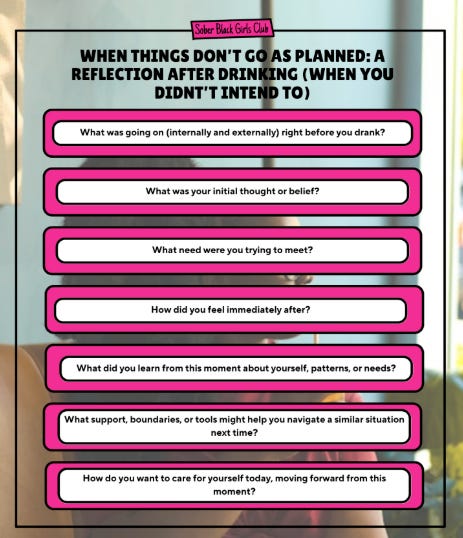
KAO: Thank you. So, I decided to create a blog and document my experiences in the rooms, sobriety, and all of it. I was still drinking and relapsing, even though I was going to meetings. Alcohol really is cunning, baffling, and powerful. Not necessarily only alcohol, but addiction in general. I’m a functional addict. I can go to meetings, I can do all these things, come home, and still need to drink.
I was invited to be on Red Table Talk, and I shared my story about my relationship with alcohol. I talked about how when I was growing up, I didn’t even know that girls like me could have drinking problems. I shared about graduating and falling into a deep depression. After that, other Black women reached out to me to say things like they weren’t sure if they had a drinking problem, but they related to my story.
I also realized that growing up, I never had representation of girls like me with drinking issues. In shows like Family Matters, there was usually one episode with a family member who drank too much, but it was usually like one night out, and that was it.
KM: Right, and then there was a stern talk with the parents, and then it was fine.
KAO: Yeah, it wasn’t like an ongoing theme in any of the sitcoms or TV shows that I was interested in. I didn’t have anyone to compare myself to. That was the gist of my share on Table Talk, and I think a lot of Black girls could relate. There’s a lot of masking in our community, not only among ourselves, but also in the medical field and among people in general. Society doesn’t tend to see Black people—especially Black women—struggle without demonizing them or making them this horrible stereotypical character of a person.
That’s how we started. Black women saw my interview, and we started to get together. During quarantine, we met on Thursdays on Zoom and just talked. From there, it grew into an organization. I still go to meetings. I go to Recovery Dharma meetings and, if I’m in the mood for it, 12-step meetings.
KM: That’s awesome.
KAO: I always tell folks that we’re not professionals—we’re a peer support group, and I think this kind of peer support was missing in the recovery space. You don’t have to have 100 years of sobriety or be a doctor; you just have to be dedicated to recovery, and that’s enough to give other people hope. And SBGC is definitely an example of that.
KM: There is something so valuable about being among others who are going through the same thing. Tell me more about SBGC.
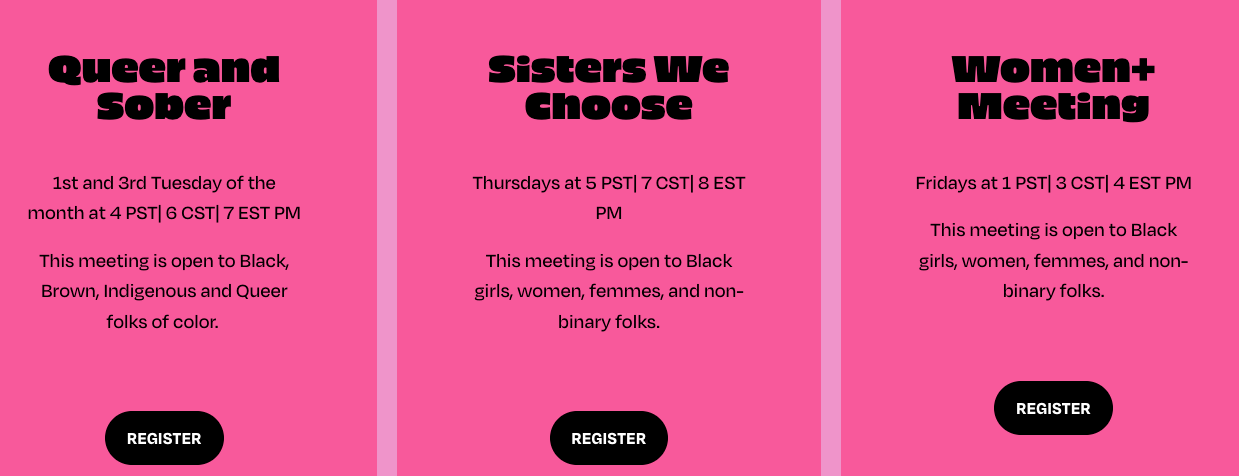
KAO: We have meetings on Tuesdays, Thursdays, and Fridays. Tuesdays are for Black, Brown, Indigenous, and Queer people of color; Thursdays and Fridays are for Black girls and women. We also have a Facebook group with over 2,000 people.
It’s hard because we don’t want to overwork ourselves. We want to be sustainable and stay around for a long time. One thing we’re trying to keep is our annual retreat, since SBGC is mostly virtual otherwise. This year we’re going to Mexico in November. We could really use more donations to make that happen. We’re still short on funds. Whatever is going on in the world, we’ve definitely taken a hit. We’re a 501(c)3, so it’s tax-deductible!
KM: I’ll absolutely include the link. It’s funny, in a weird way, SBGC reminds me of the early days of AA’s creation, when it was a scrappy, grassroots movement. Bill Wilson always said all you needed for a meeting was three people with a desire to stop drinking, and that feels similar to what you’ve done. I think we need more of that in the world.
KAO: When I created SBGC, I got so many requests from other people. People wanted me to open it to this group or that, but we obviously [can’t cater to everyone]. So, I encourage people to make their own groups and communities. I didn’t know what I was doing when I created SBGC. Something about being a high-functioning addict is that it’s hard for me to admit that I need help.
We’re in this era where we want to put everything online and make it seem like we have so many followers, but you don’t actually have to do any of that. I have rheumatoid arthritis, and that played a role in my relapses. I would drink to avoid the pain; I didn’t even know I had RA or what RA even was. But once I figured it out, it really helped to talk to other people in recovery who also had autoimmune disorders. We made connections. We made communities. Even now, when I’m having flares, I have a pocket of people I know I can talk to. People can make their own communities. It can be just two or three people. It doesn’t have to be for Instagram. It doesn’t have to look a certain way. It can just exist.
In the beginning of SBGC, I got overwhelmed because I didn’t know how to nourish my own sobriety while also running the collective. But I learned that you don’t have to be perfect to help other people. You can help simply by being in community with other people in addiction recovery. You gotta show up. You gotta be honest. But that doesn’t mean you gotta be perfect.
*
If you enjoyed this post, please like, comment, or share it to help others find the newsletter!
Want to show your support of AASL without committing to a paid subscription? Leave a one-time tip here.
Send questions and feedback to askasoberlady@gmail.com. By sending a question, you agree to let me reprint it in the newsletter with your name redacted or changed. Emails may be edited for length or clarity.
I’m not a doctor or mental health professional, so my advice shouldn’t be construed as medical or therapeutic. You are free to take or leave it.
I feel like it's such an accomplishment that Khadijat created a peer support group for recovery outside of 12-step orthodoxy. I've been in so many 12-step rooms that push back on the very idea of groups that cater to or only allow certain identities. I respect the ideal that's often behind that, how we're all just alcoholics, but it can also be flattening and dismissive of actual lived experiences.
I'm so glad to have learned about Sober Black Girls Club. Khadijat rocks!