

All AASL posts are free and accessible to anyone, but paid subscriptions make that possible. Please consider supporting this recovery resource by upgrading to a paid subscription.
Hi Sober Lady,
I was thinking recently about the people in my life (including me) who have grappled with addictive behaviors. It really feels like most of us have just swapped one destructive, addictive tendency for something slightly less so or maybe healthier, arguably.
Like swapping a compulsion towards drinking alcohol with smoking weed or binge eating towards spirituality/meditation/exercise — or any of these behaviors with far too much screen time on our phones/social media.
It sort of makes me depressed. Will there ever be a time when we aren’t seeking “something more” or the high of a dopamine hit? Are there people who successfully move away from one addictive behavior without seeking to replace it with something else?
All my best,
Curiously Confused
Hi CC,
I love this question because it’s a great example of two important, interrelated recovery concepts: harm reduction and the continuum of substance use (and behavioral) disorders.
First up: Harm reduction. HR is most often discussed in relation to people who use drugs, but it applies to countless concepts. Needle exchanges for people who inject drugs, free condoms for college students, and seatbelts in cars and child carseat laws are all harm reduction efforts. They’re predicated on the reality that people will always engage in activities with some degree of risk, and instead of simply telling them to stop or hoping it all works out for the best, you can implement policies that reduce the risk of harm associated with the inevitable behavior.
Your example of “swapping a compulsion towards drinking alcohol with smoking weed” is an example of harm reduction. In general, compulsive alcohol use is far riskier from an individual and public health perspective (accidents, overdose, etc.) than compulsive cannabis use. That doesn’t make cannabis use healthy or mean that cannabis use disorder doesn’t exist, just that one behavior is associated with more harm than the other. Thus, in my view, harm reduction is always a good thing. It may not always be the best thing or one’s desired outcome, but by definition, there is inherently less risk of harm in the new habit than the previous behavior.
Of course, people don’t always go from a harmful substance or behavior to a less harmful replacement. And, as you note, there are certain dopamine drivers (screens, internet, social media, sugar, caffeine) that are more likely to create dependence and/or addiction.
We all have things we’re dependent on. These dependencies change over time, as well as in response to cultural and societal norms. For the last week and a half, I haven’t had internet at my house. By the time we hit day three, I was irritated; by day five, I was furious; and by day seven, I thought I might crawl out of my skin. To some, that might seem like an addiction. To anyone in 1998, losing my mind over one week of lost internet would have been grounds for institutionalization.
But in my circumstances in 2025, it wasn’t an unreasonable reaction (if I do say so myself). Cell coverage in my area is notoriously bad, so without internet, I was mostly unable to communicate or do any work. I ventured out to libraries and coffee shops to get things done, but it was annoying. I like working at my house! I have a whole office for that very reason. I won’t die without home internet access, but I’m unquestionably dependent on it.
In the grand tradition of “literally,” the word “addiction” is overused to the point that its true meaning is often diluted. People say, ‘I’m addicted to the TV show Slow Horses,’ or ‘Cherry Garcia ice cream is my addiction,’ when they really mean, ‘I enjoy these things frequently,’ or ‘this is an important habit in my life,’ or ‘this is how I treat myself after a hard day.’
Early in my sobriety, I mentioned to a coworker that I was going to AA. They chuckled and said, “Isn’t that just a replacement addiction?” which I found extremely funny. That idea was so divorced from my experience that I couldn’t even be offended. Sure, it was a “replacement” in the sense that I used to do one thing every day and now I was doing something else every day, but that’s where the similarities ended. I did the first thing all day, every day, and it was literally killing me; the second thing I did for—at most—an hour or two a day and never once put me in mortal danger.
Rather than focusing on a specific substance or behavior, it’s far more useful to look at how a person’s substance use or behavior is affecting their life. This is where the continuum of substance use (and behavioral) disorders becomes really important.
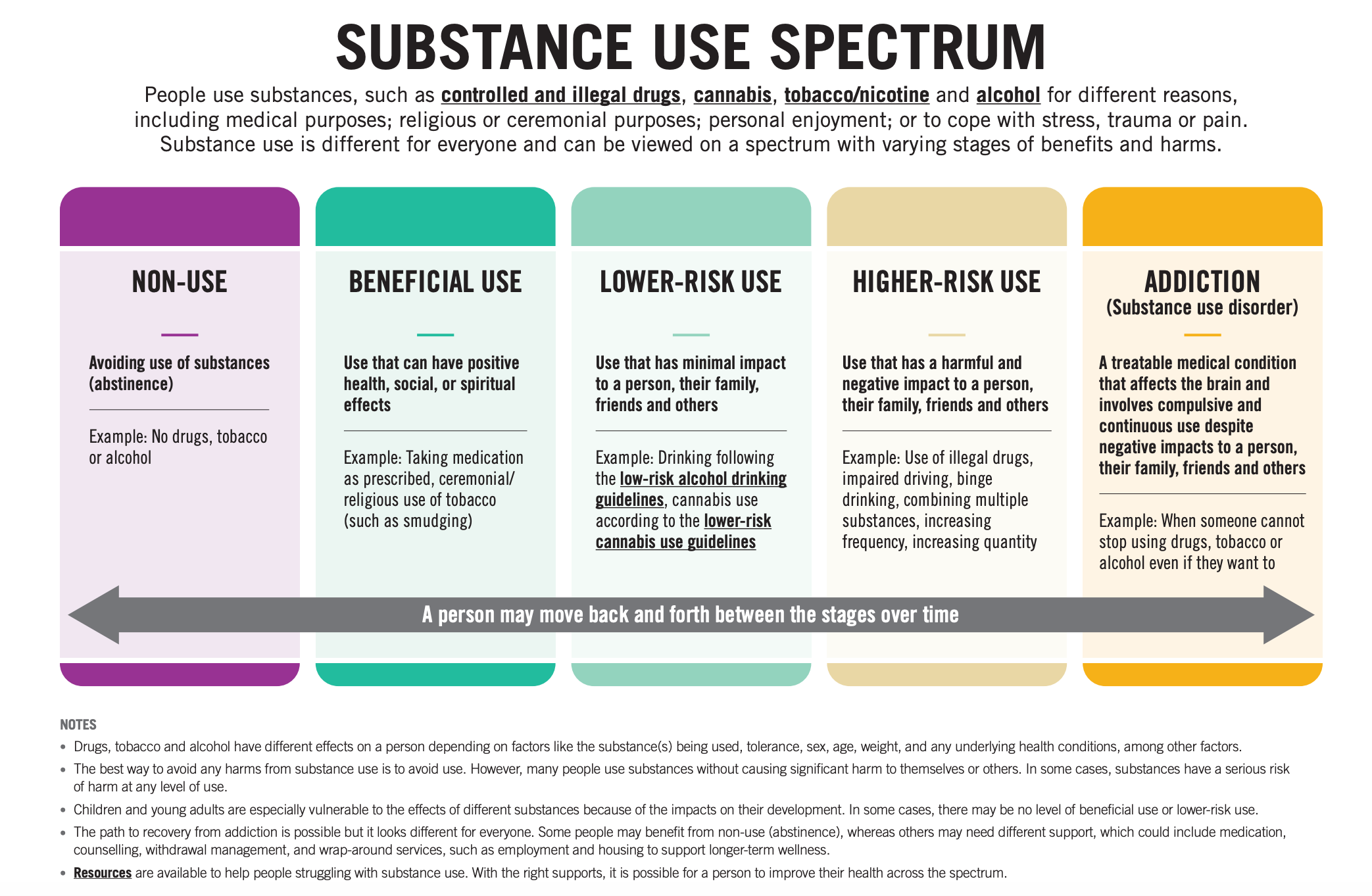
As an example, you mentioned someone who goes from compulsive binge eating to excessive focus on meditation and exercise. That shift could be entirely healthy or profoundly disordered. To determine if a patient has a substance use disorder or a gambling disorder, clinicians ask the questions at the end of this post. The more questions a person answers affirmatively, the more the patient falls on the “severe” end of the spectrum. You’ll notice that the questions are about home life, control, feelings, and health, rather than the specific substance or even the frequency of use.
In other words, what might look like a ‘replacement addiction’ might be an intense new interest with little to no negative (and perhaps positive) consequences. Even if someone is SUPER into meditation, for example, the likelihood that it’s having a negative effect on their life is much lower than it would be with, say, cocaine.
That’s great news because there’s a real freedom in knowing what to watch for when it comes to disordered behavior or substance use. For example, I play a lot of word games on my phone. I’m really intense about my Quartiles and Wordle streaks. I play too much online Scrabble. There have absolutely been occasions when these things interfered with my work. Fortunately, that’s the only negative consequence I’ve encountered, and it’s not a daily occurrence, so I feel ok about it.
Does it trigger the ol’ dopamine reward system? Sure, but only briefly. I get a hit of dopamine when I open the app and another when I complete the puzzle or take a good turn, but “dopamine hits” aren’t inherently bad. While most people think of it as the “pleasure” neurotransmitter, dopamine actually drives us to seek the things that might be pleasurable.
Without dopamine, we might never try anything new. We might never experience the giddiness of a first date or push ourselves out of our comfort zone to do karaoke or try rock climbing. The trick, as Rachel Barr says in How to Make Your Brain Your Best Friend, is to know that dopamine’s role is pleasure-seeking, not pleasure-feeling.
If you’ve struggled with addictive tendencies, it’s understandable that you’d be wary of anything that offers a “dopamine high,” but substances and behaviors that trigger a dopamine release are not inherently bad. Just keep in mind that a large part of its role in your brain is to keep you looking for the pot of gold at the end of the rainbow. That search might result in wild and wonderful things, even if the gold never materializes. Just don’t lose yourself, your relationships, or your peace of mind in the hunt.
If you enjoyed this post, please like, comment, or share it. Doing so helps others find the newsletter!
A Substance Use Disorder is diagnosed when someone meets two or more of the 11 criteria within a 12-month period. Severity is based on the number of criteria met. Taking the substance in larger amounts or for longer than you’re meant to
Taking the substance in larger amounts or for longer than you’re meant to
Wanting to cut down or stop using the substance, but not managing to
Spending a lot of time getting, using, or recovering from use of the substance
Cravings and urges to use the substance
Not managing to do what you should at work, home, or school because of substance use
Continuing to use, even when it causes problems in relationships
Giving up important social, occupational, or recreational activities because of substance use
Using substances again and again, even when it puts you in danger
Continuing to use, even when you know you have a physical or psychological problem that could have been caused or made worse by the substance
Needing more of the substance to get the effect you want (tolerance)
Development of withdrawal symptoms, which can be relieved by taking more of the substance
The only behavioral addiction recognized in the DSM-5 is gambling disorder, but it’s not hard to apply the criteria to other behavioral addictions:
The person must meet four or more of the nine criteria within a 12-month period:
Needs to gamble with increasing amounts of money
Restless or irritable when trying to cut down or stop gambling
Repeated unsuccessful efforts to control, cut back, or stop gambling
Preoccupation with gambling
Often gambles when feeling distressed
After losing money gambling, often returns another day to get even
Lies to conceal the extent of involvement with gambling
Jeopardized or lost a significant relationship, job, or educational/career opportunity
Relies on others to provide money to relieve desperate financial situations
Send questions and feedback to askasoberlady@gmail.com. By sending a question, you agree to let me reprint it in the newsletter with your name redacted or changed. Emails may be edited for length or clarity.
I’m not a doctor or mental health professional, so my advice shouldn’t be construed as medical or therapeutic. You are free to take or leave it.
My personal experience is that you "grow" into sobriety. In other words, as you learn, understand and practice recovery behaviors you become less likely to engage in alternative addictions. The "happy, joyous and free" tends to look more like contentment. Walking the walk, instead of talking the talk means I actually practice my recovery behaviors. I am not perfect at it, by a long shot, but I am content.
Thank you so much for this explanation. My (sober) spouse likes to call exercise a “positive addiction,” which, ok, but your perspective pivot is helpful.