

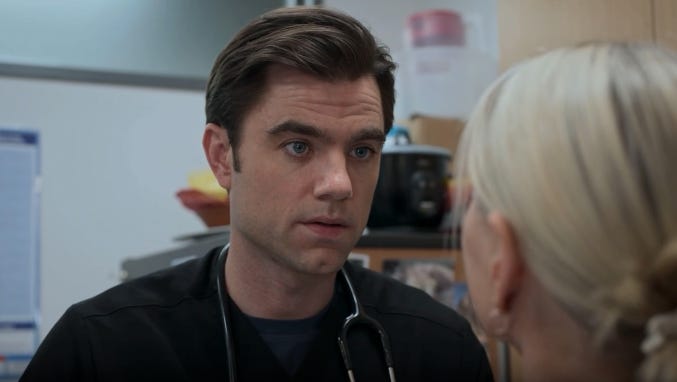
Welcome to the second installment of Making a Scene! This post contains minor spoilers for Dr. Langdon’s character in Season 1 of The Pitt, as well as episodes 1, 6, and 7 of Season 2.
This is a reader-supported publication. All posts are free, but paid subscriptions keep the newsletter alive. If you want to support my work, consider becoming a free or paid subscriber.
Like most people who’ve seen the critically acclaimed show, I love “The Pitt.” I love how accurately it grapples with the United States’ broken healthcare system, the fantastic portrayal of utterly selfless yet complex and human healthcare workers, the trauma they witness and experience daily, the drama of common but catastrophic injuries and illnesses, and all things Dr. Robby (Noah Wiley).
Each episode of the show takes place over one hour of a single ER shift; the entire season spans a single day at the hospital. Last season, we learned that Dr. Langdon (Patrick Ball), Dr. Robby’s former protégé, was addicted to benzodiazepines and had been stealing them from patients and the hospital in service of his addiction. When Robby discovers the missing medication in Langdon’s locker, they have the following exchange:
Season two begins ten months after the end of Season one’s shift. It also marks Langdon’s first day back at the hospital after completing a rehab program for his addiction. And hoo, baby, Langdon is itching to make his amends. (Relatable, but more on that later.)
For the uninitiated: Steps eight and nine of the twelve-step programs involve making a list of the people you harmed and making “direct amends to such people wherever possible, except when to do so would injure them or others.”
I love the amends process. It’s one of the most valuable tools I learned during my time in AA. Anyone can toss out an “I’m sorry,” but amends are more substantive. When I was trying to hold my life together because my drinking was causing it to unravel, I spewed apologies indiscriminately, like they were a magic adhesive that could hold my world together. We see Langdon do this in the scene with Robby at his locker.
Ideally, amends are a holistic apology. First, you give serious, careful thought to how your actions affected others and make that fun little list (just kidding, it sucks). Then, you take accountability for those actions, make restitution wherever possible, state your commitment to not repeating that behavior, and, finally, give the person who was harmed the opportunity to air their grievances without responding defensively or assigning blame. (If you missed it, Melissa Petro and I chatted about amends a few weeks ago.)
How should this process be undertaken? According to the twelve steps, “good judgment, a careful sense of timing, courage, and prudence—these are the qualities we shall need when we take Step Nine.”
Good judgment, a careful sense of timing, courage, and prudence, you say? Let’s check back in with Season two Langdon.
His first apology comes in the first hour of his first day back. Langdon’s first patient just happens to be Louie, the patient from whom he stole Librium. Despite the eye-popping choice to unburden himself while Louie is in extreme pain and again under his care, it’s not a terrible amends. It comes off as more honest than the other amends we’ll see (thus far) in Season two.
There are a few factors that allow Langdon to be more humble and honest when apologizing to Louie: First, he’s apologizing for a specific incident/action, rather than the…everything he’s going to have to talk to his coworkers about. Then, there’s the fact that Louie has late-stage alcoholism. If anyone is going to understand why Langdon did what he did, Louie’s the guy. Finally, he’s a doctor and Louie was his patient. Betraying and potentially harming a patient violates every ethical guideline a doctor has, and that matters to Langdon.
You can see Langdon accepting responsibility as he faces Louie head-on (again, despite being in the goddamn ER) when he says, “It was not only wrong and utterly unprofessional, it was a betrayal of my Hippocratic Oath, and a fucking crime.”
Crucially, he gives Louie the option of seeing another doctor, which (both here and in real life) is an important and often forgotten part of amends—letting the person you’ve harmed determine what relationship, if any, they want to have with you moving forward. Of course, because they’re in the middle of the ER, Langdon gets pulled away before Louie can answer (the clip above jumps from Langdon’s amends to his return to Louie’s exam).
Interestingly, many people on Twitter and Reddit think this was the worst amends, so feel free to tell me why I’m wrong in the comments (unless you’re a lawyer and you’re going to say ‘liability’, in which case, I don’t care).
In a nod to both realism and How Not To Amends, it all goes downhill from there. Langdon’s next amends (same day, just a few hours after Louie’s) are for Dana, the no-BS charge nurse at whose feet I worship. Classically overeager and still not quite grasping the importance of time and place, Langdon approaches Dana in the staff breakroom, while other staff stroll in and out.
As is often the case with people hungry to get past the 9th step in hopes of getting things “back to normal,” Langdon lunges at his first opportunity to talk (semi)privately with Dana. The charge nurse is just trying to get coffee on one of her minuscule breaks when Langdon starts talking about how many of the staff seem reticent about his return. He then launches into his apology, telling Dana, “I’ve been working the 12 steps, trying to make amends. I was really selfish. I lied to myself. I lied to you. I’m really sorry.”
Oh, Langdon, you adorably misguided newbie. How were you selfish? How did your lies put Dana's (and everyone else’s) jobs at risk? When did you realize just how badly you could have harmed patients? What do you want Dana to know going forward? What does she need from you going forward? These are things you might have thought to include in your amends, if you weren’t in the goddamn breakroom of an ER!
This is clearly not Dana’s first 12-step amends rodeo, nor is she in the mood for a lengthy chat. She tells Langdon, “You can check me off your list, kid. We’re good.”
We’re now almost seven hours into the shift, and Langdon is raring to find the person he’s been amends-hunting all day: Dr. Robby. Langdon tells Dana as much. The wise nurse suggests that it may not be the best idea and advises him to let Robby “finish the day in peace.” Naturally, Langdon listens to her and backs off, knowing that part of Step Nine is “to remember that we cannot buy our own peace of mind at the expense of others” (in other words, don’t force your amends on people who don’t want them).
Just kidding, Langdon is determined to make his third* amends of the day. And suddenly Robby and Langdon are stuck in an elevator together! If he absolutely had to do it today (he doesn’t**), in the ER (he doesn’t), surely this is the time? Nope. He waits until he and Robby are on the roof watching a helicopter carrying a critically injured patient descend. Dr. Langdonadangadingdong, what are you doing?! As you can see in the clip below, it doesn’t go well.
A quick glance online was enough to know some viewers were appalled by Robby’s response, but I loved it. Like so much of what makes the show great, it felt painfully real. Robby’s dealing (or, more precisely, not dealing) with his own mental health stuff, and he’s still furious with Langdon. So Robby says what he feels: he doesn’t want Langdon working in “his” ER after stealing drugs from patients there. It may not be the most compassionate response, but it is understandable. While part of Robby’s anger is a shield against the betrayal and hurt he feels, some is also deflection—it’s been clear since that locker scene that Robby is as angry with himself as he is Langdon.
Given how taken aback Langdon looks, it’s clear that he expected Robby to respond more like Louie or Dana—with something closer to absolution than condemnation.
And that’s how you know those amends needed to bake a little longer, or at the very least be done in a different setting: For everyone’s benefit, you have to go into an amends without the expectation of forgiveness. You have to be committed to doing things differently because you’re committed to doing things differently, not because you’re trying to coerce a certain outcome.
Langdon’s apology tour is a masterclass in the wrong way to do amends, but it’s also extremely relatable (minus the helicopter part). In twelve-step groups, the healing powers of the amends process are endlessly discussed. It’s not unusual for people to want to jump right in. I wanted to jump right in. But I was always told that the reason making amends is so far down the list of steps is because it takes steps 1-8 to be ready.
I think there is some wisdom in that. Whether or not you’re doing them as part of a twelve-step program, amends deserve to be done slowly and methodically—it’s what differentiates them from previous, superficial apologies.
Langdon has been away for ten months and is understandably anxious to clean up his mess and get back to work. But it’s also the first day that he’s seen any of these people. He’s ping ponging around the hospital, searching for people he can apologize to, whether they want to hear it or not. In other words, he’s trying to buy his own peace of mind at the expense of others.
After watching the episode, a friend sent me a clip from the Prestige TV podcast, where someone in recovery writes in and says that Langdon is actually doing his amends too slowly, and that twelve-step groups in the letter writer’s area try to get people through all 12 steps in 90 days. 90 days! That is bonkers to me, but if it’s something that happens in your area, let me know in the comments because....I have questions. And please share your thoughts on Langdon’s amendsy first day back.
It’s interesting that the trickiest amends on Langdon’s list is one he hasn’t even attempted: Dr. Santos, who told Dr. Robby about his med-stealing in Season one. I don’t blame Langdon for avoiding that particular interaction, but we all know he can’t finish his amends until he talks to her. It’s going to be uncomfortable, and I can’t wait.
*Some will argue that Langdon did an amends with Mel, but I’m not counting it because it’s not clear that he ever ‘wronged’ her—I think it was an easy stop on his amends marathon.
**I know Robby’s leaving the following day, but amends—especially if you’re not going to be interacting with the person in the meantime—can wait until there’s a good time and place.
If you enjoyed this post, please like, comment, or share it. Doing so helps others find the newsletter.
Send questions and feedback to askasoberlady@gmail.com. By sending a question, you agree to let me reprint it in the newsletter with your name redacted or changed. Emails may be edited for length or clarity.
I’m not a doctor or mental health professional, so my advice shouldn’t be construed as medical or therapeutic. You are free to take or leave it.
I agree with every word you wrote, and I have always found it surprising to hear of programs that have recovering addicts cycle through the 12 steps in 90 days. My first time through the steps took about three years. My understanding and practice of the 9th step is one focused on making amends, meaning actively correcting mistakes and my behavior. The impulse to make the amends too soon and in some dramatic way, in my opinion, is just a symptom of the self-centered nature of addiction.
The "I'm sorry" part is meaningless if I have not done the work to change my behavior. It does more harm for the relationship if I fall back on old behaviors...not to mention what it teaches that person about "all addicts." I think about the harm I could do to others who are also on this journey.
So appreciate your writing. Thank you.
This is such a fascinating reflection on amends — when and how to do them. Frankly, I wish there were programs outside of AA teaching this concept more widely, because plenty of folks who don’t experience addiction wrong people in terrible ways and don’t understand how to make amends.