

Note: I started this newsletter almost exactly two years ago, and it’s grown and evolved in ways I never expected. It’s become more than an advice column, more than a side project, and brought me more satisfaction than I ever imagined. And yes, it’s been more work than I initially envisioned, too.
One thing that hasn’t changed is my commitment to ensuring all the posts are free. Cost should never be a barrier to information and conversations about substance use and addiction recovery.
Unfortunately, that means I have to rely on readers volunteering to upgrade to paid subscriptions ($5/month or $50/year) to keep the newsletter afloat. If you haven’t done that yet, but are in a position to do so, upgrading is the best way to ensure AASL has more birthdays in its future. If that’s not possible right now, sharing the newsletter with others is also a great way to support this work.
I only skimmed the story because I was sure I knew how it ended. Stories with headlines that include the words “Woman, hiker, dead, remote, naked, suspicious, neck,” tend to end a certain grisly way. I assumed what you probably assumed—what anyone who pays attention to the news would assume—that somewhere out there was a boyfriend, a spurned hiking partner, a forest-dwelling madman, or some other creep responsible for the woman’s death. It felt like a tragic story I’d read too many times before.
This was in April. A pair of hikers in Big Sur had found her face down in a pool of water on Pine Ridge Trail, wearing only a sports bra. They told news outlets that they glimpsed a gash on her forehead as well as suspicious markings on her neck. She was quickly identified as Joanna Ruth Shields, a 37-year-old hiker and skateboarder.
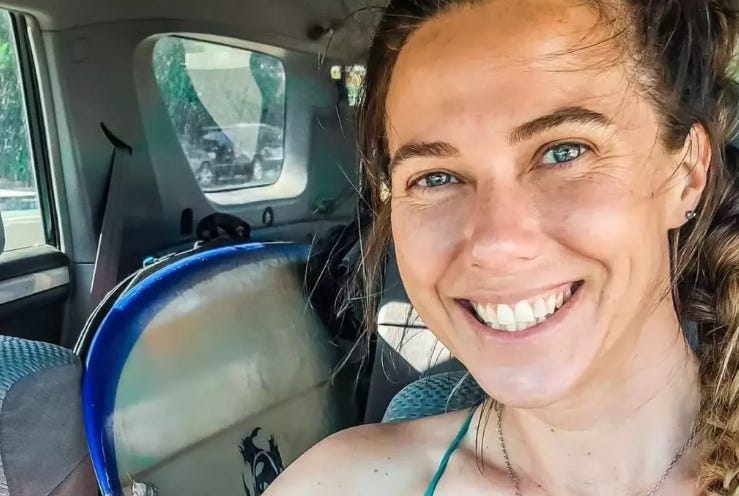
News stories about Shields’ death spread rapidly across social media; the accompanying photos showed a quintessential outdoorsy California girl. She looked like someone I would have become friends with at summer camp. Someone who was on multiple sports teams in high school but also hung out in the park to slackline with hippies. Someone people would describe as vivacious.
I remember thinking that I hoped they’d catch the guy who did it. Then, I forgot about the story entirely.
But a few weeks ago, I started seeing new headlines about the “shocking cause of the Big Sur hiker’s death.” The tawdriest publications made sure to include that she was found naked and with “mysterious marks on her neck,” though by this time the outlets knew that neither her nudity nor the marks on her neck were relevant to her death.
According to the sheriff-coroner of Monterey County, Shields’ cause of death was “probable alcohol withdrawal seizures due to chronic alcohol use disorder.” In a press release posted on July 23rd, the sheriff’s office said that the marks on her neck were the result of “postmortem insect activity” and the gash on her forehead was superficial and didn’t contribute to her death.
I was surprised. So many of the details about how and where her body was found seemed to suggest an attack, though of course all of the “evidence” was circumstantial; it was always possible there were non-nefarious explanations. For example, her hiking buddy told authorities that the last time he saw Shields alive, she said she was going to the bathroom and to wash up, potentially explaining the nudity.
Her friend told the hikers who found her body the same story, though no one seemed particularly inclined to believe him. News reports described the hikers’ interaction with Shields’ friend as “a chilling encounter,” though neither the hikers nor the news outlets explained exactly what made it so. It seemed like everyone was primed for a Gabby Petito-esque tragedy.
Many of my assumptions about Shields (and her cause of death) were based on pictures of her that accompanied the news stories. In them, Shields looked young, healthy, happy, outdoorsy, so I assumed she was all of those things. Indeed, reports from her family and friends suggest she was many of those things. But we now know that she was also very ill.
In its statement, the Sheriff’s office explained its conclusion about alcohol withdrawal was the result of “forensic examination, a reliable medical and health history, and information obtained from Ms. Shields’ family during the investigation.” Of course there was more going on with Shields than anyone could glean from a few photos; we’ve all lived in an Instagram world long enough to understand that. But that didn’t stop me from falling headfirst into the appearance trap. I fell into it despite knowing better than most how deceiving appearances can be.
For most of my life, I was chronically underweight. At first, there was no real reason for it—I was just a skinny kid. Later, I discovered I had an undiagnosed colon issue and needed surgeries, all of which led to dropping more weight and a significant change in diet. Until recently, the only time I had a “normal” Body Mass Index* was after I graduated college, when I started drinking roughly a fifth of vodka every day.
Drinking that much every day boosted my caloric intake faster than eating ever could. Food was not terribly important to me; drinking was the most important thing in my life. Though they didn’t know the reason for the change, people who had been worried about my perpetual stick-thinness suddenly rushed to tell me how good I looked. How I finally looked “healthy.”
Similarly, when I first started going to AA meetings, old-timers liked to joke that they “spilled more than I drank.” They, too, fell into the appearance trap. All they saw was a fresh-faced (courtesy of a month in rehab), 23-year-old woman starting her adult life.
They didn’t know I’d spent the nine months before rehab waking up with shaking hands and a jittering heart, or that I’d survived a .4 blood alcohol content, or that doctors had told me my liver enzymes were at levels they’d expect to see in a middle-aged alcoholic male. They never implied I wasn’t welcome at the meeting or didn’t belong, but there was an immediate assumption about my history based exclusively on my appearance.
Societally, we don’t think of women in their 20s and 30s as likely candidates for the kind of chronic alcohol use that can result in fatal withdrawal, but that’s a mistake. It happens, as do fatalities from other alcohol-associated conditions. (Despite the many headlines about younger generations forgoing booze, alcohol-associated liver disease is on the rise among young adults, especially young women).
Too often, we think we can identify someone with an addiction just by looking at them. We think we know what health looks like. And, especially when it comes to women’s appearances, people feel entitled to comment on them.
When I was actively addicted to alcohol, I looked for anything that might suggest the problem was not as bad as I knew in my (palpitating) heart that it was. I remember smugly leaving a friend’s house after her parents remarked on how “healthy” I looked, knowing there was a water bottle of vodka in my car just a few feet away.
I know her parents cared about me and were only trying to be supportive. I love them dearly. But I took that word and ran with it. It spun through my head on a self-satisfied loop the whole drive home. Healthy healthy healthy. I knew it wasn’t true. But their belief that it was—after so many years of concerned looks, whispers, and unrequested extra helpings of food—felt almost as good as if it was.
At the time, I knew that I was physically dependent on alcohol. I knew what the shakes were and I knew that alcohol made them go away. I knew they were a bad sign and I knew that they would probably get worse. I didn’t, however, know that alcohol withdrawal can actually kill you.
Maybe Shields didn’t know it either—a lot of people don’t. Maybe she thought she could power through and come out the other side. Maybe she went to Big Sur to do exactly that. Or maybe it all happened by accident. Whatever the circumstances, it’s a tragedy—deepened by the reality that it could have been avoided with proper medical care.
I’ve been trying to wrap my head around the idea that we’re more surprised by a 37-year-old woman dying from alcohol withdrawal on a backpacking trip than from a violent attack. On one hand, I get it. An entire (true crime) industry is based on stories that begin exactly like this one. I can’t fault anyone for making the same assumption I did.
Some people seem almost disappointed by the truth. Days after her cause of death was confirmed and months after the markings on her neck were identified as the work of insects, new posts like the one below popped up all over the internet.
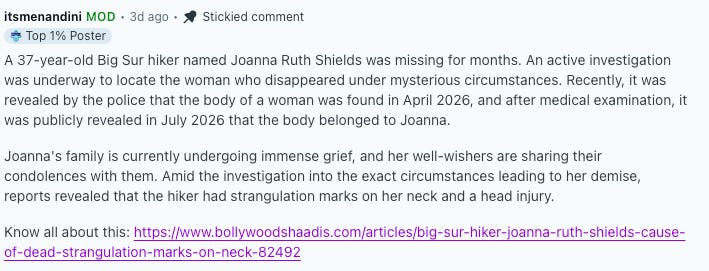
There are people who want this story to be something it’s not. There’s something unsatisfying about mundane explanations for details that seem so dramatic—the kinds of details we’re used to following on true crime podcasts and Reddit message boards. Those stories animate and enrage us. They have a perpetrator—someone to hunt, someone to blame, and someone who might eventually be brought to “justice.” There’s a villain and a victim.
The true story of Shields’ death is villianless. There’s only the unsettling, heartbreaking reality that she died far too young, alone on a trail in Big Sur, from alcohol withdrawal.
There is no silver lining to her death. I wish she’d had more time. I wish she hadn’t died alone. I wish she’d been closer to medical care. That it happened at all can remind us of a few important realities: Appearances can be deceiving, and assumptions can be deadly. Not everyone knows about the dangers of abruptly stopping chronic alcohol use. No one is immune to pain, the desire to anesthetize, or how their brain responds to that anesthesia. Dying from alcohol withdrawal may be less dramatic than a fatal, violent attack, but it is no less tragic.
*The Body Mass Index was created in the 1830s by a mathematician (not a doctor) and is useless for gauging an individual’s health, but doctors insist on using it anyway. For more on that: https://pmc.ncbi.nlm.nih.gov/articles/PMC10693914/
*
If you enjoyed this post, please like, comment, or share it. This helps others find the newsletter!
Want to show your support of AASL without committing to a paid subscription? Leave a one-time tip here.
Send questions and feedback to askasoberlady@gmail.com. By sending a question, you agree to let me reprint it in the newsletter with your name redacted or changed. Emails may be edited for length or clarity.
I’m not a doctor or mental health professional, so my advice shouldn’t be construed as medical or therapeutic. You are free to take or leave it.
"No one is immune to the desire to anesthetize" is pointed and real. I wish for us, as a culture, that we examined the questions around why someone is called to numb and dissociate and created models of support around that experience.
Even as a sober person, I still recognize these impulses in myself. When I have a lot going on, or consequential decisions weighing on me, I notice myself crushing a six pack of seltzer water. While not inherently dangerous like some of the former ways I coped, there is some part of me calling for care. Learning how to recognize and commune with that part not only impacts my health, but it's also how I am able to participate more fully in the vision of life I have for myself.
Looking great on the outside; dying on the inside. Heartbreaking.