

Hi Friends, thank you for your patience as I took a break from the newsletter after Sally’s death. Thank you also to everyone who responded to the newsletter survey—I’m going to leave it open and promote it a few more times here because the more feedback the better. But if you already took it, please know that I read every response and am so appreciative of your kind words and thoughtful suggestions. Thank you, thank you, thank you.
AASL is 100% reader-supported; paid subscriptions allow me to keep all the posts free. Thank you for reading, and I’m glad you’re here!
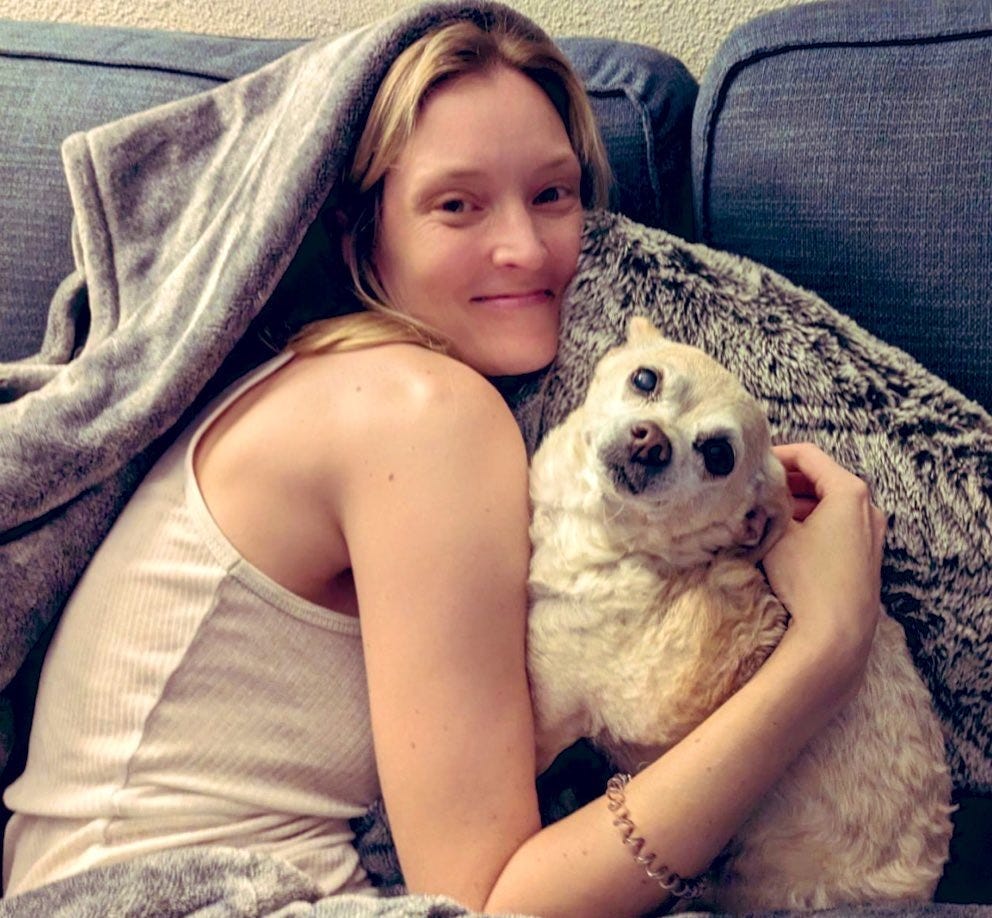
Anyone who has ever loved a dog has a story about how they fell in love with that dog. Mine is also the story of my recovery from alcohol addiction.
Three milestones in my history are inextricably linked in my brain: becoming an adult, getting sober, and falling in love with a small rescue dog named Sally. There’s so much overlap between the first two that it's impossible to know where one ends and the other begins.
I was 23 years old when I was forced to confront the reality that I was profoundly addicted to alcohol. It was the year I quit drinking, which is to say the year I stopped numbing every uncomfortable feeling; it was the year I learned to ask for help and take accountability for my actions, and the year I got and kept my first ‘grown-up’ job.
These changes are something that are a part of many people’s transition to adulthood, but for me, they were also undeniably the product of getting sober. None of it came easily—I spent the year feeling like a newborn deer, testing out thin, shaky legs on uneven ground, easily spooked, more often confused than not—but at least I was up and moving.
A year and a half later, I was renting my very own apartment, attending AA meetings, and in a relationship that wasn’t riddled with secret drinking and thinly veiled lies. Neither life nor sobriety was easy, but I was cautiously learning to navigate both.
My boyfriend, Charlie, asked me to go with him to pick up a dog he’d decided to adopt. She was deeply traumatized, he told me; she was a chihuahua who had been rescued from a dog-fighting ring where she was used as bait. She was so traumatized that three other families had returned her to the shelter after adopting her.
Despite loving the dogs my grandparents had when I was growing up (and begging my parents for one of my own), I was nervous about the proposition. I’d never been responsible for a dog before, much less a traumatized one. I had only recently learned how to care for myself—and I don’t mean dealing with my own trauma. “Caring for myself” meant taking my antidepressants, not drinking under my desk at work (or anywhere else), and paying my bills on time.
I reasoned that Charlie would be her primary caretaker, and I would essentially enjoy “fun aunt” privileges—taking her on walks and giving her treats, but the heavy lifting, like vet visits and obedience training, would be left to him.
The people at the shelter told us it was important that Sally walk into Charlie’s apartment on her own, so she felt like she was there by choice. We set her down outside the threshold of his apartment and watched her skeletal body tremble so violently you almost expected to hear her bones rattle against each other. She looked at us with wide, terrified brown eyes. She would not move.
Charlie went to get treats to try to lure her into the apartment, and she and I stared at each other, equally uncertain about what I was doing there and the role I would play in her life.
It took her at least half an hour to cross that threshold. I sat on the other side, with treats lined up in a row from one side of the doorway to the other. After about 15 minutes, she ventured to sniff and then cautiously lick a treat. From there, she slowly inched forward—still trembling and never taking her suspicious eyes off me, even as her pink tongue found the next treat and she inched forward again. When she finally made it into the apartment, I slowly scooped up her tiny, trembling body and kissed her head. She continued to tremble and look at me the way a mouse might an open-mouthed snake.
Charlie did indeed do the heavy lifting for the first many months of Sally’s life with us; I can’t take credit for that. He did an incredible job. But I became increasingly enchanted with her, and eventually Charlie got a second dog. He suggested I take Sally to obedience classes at the Humane Society, and he would take the other pup.
Something about those classes bonded Sally and me—I’m sure the little bits of hot dog and cheese we were instructed to bring as rewards for good puppy behavior played a significant role. Soon, she was following me around and having sleepovers at my apartment, where I let her sleep in my bed, something that was forbidden at Charlie’s.
When Charlie and I broke up, we both knew I’d take Sally. Somewhere along the way, I had become her human and she my dog. Like a truly neurotic person with multiple lawyers in her family, I made us get adoption transfer papers. I knew Charlie wasn’t the kind of person to renege on our verbal agreement, but I wasn’t leaving anything to chance. The thought of losing her, of going forward without a document that explicitly stated that she belonged to me, was unthinkable.
Clearly, I was already being very normal about this dog.
At the time, I was a public librarian. Sally went out with a dog walker during the day, and when I came home in the evening, the first thing I did was drop my bag to the ground and fall to the floor. She’d spring over and jump on my prone body, licking and yipping with so much excitement that I think we both could have died from happiness.
She was still scared of the wider world—I hadn’t completely gotten over that anxiety myself—but with each other, there was an unbridled joy, a balm that seeped into all the places that I felt broken and wounded. I never felt more whole, more loved, and more loving than when I was with her.
I was still in AA at the time, and my sponsor was having me make gratitude lists before bed (an annoyingly effective practice). I knew I was supposed to put my sobriety as the number one thing I was grateful for, but night after night, something else took the top spot. Sally. Always Sally.
I have so many stories about her that sound made up. How the shelter randomly picked a birthday for her—months before I would even meet her—and it happened to be the exact same day I got sober. How she could tell the difference between when I had a migraine and just wanted a nap—cuddling with me during the latter, perched vigilantly at the foot of my bed as if to guard against anyone who might turn on the lights or otherwise interrupt my rest during the former. How she could tell even before I could that something was making me anxious and would wake up from a deep sleep to crawl into my lap.
In AA meetings, people would talk about being grateful that their child had never seen them drunk; I’d joke that I was glad Sally had never seen me drink, laughing because obviously a dog is not a child, but secretly meaning it. I knew that if I had been drinking, I could never have properly cared for that dog, not because I wouldn’t try, but because it’s very hard to keep something else alive when you are trying so hard to die.
In August of 2021, she was diagnosed with congestive heart failure. We knew it was coming; she’d already been on medication to try to slow the onset. Best case scenario, the vet explained, we had 1-2 years with her.
“Take a lot of pictures with her this Christmas,” the cardiologist told us, giving us a sad, kind smile. I tried to smile back like I wasn’t filled with the overwhelming desire to smash everything in her office.
Fear invaded my body like a cancer. In January of 2022, we moved from California to Washington, and I was terrified that the stress of the abrupt change would kill her. Years earlier, when I’d just moved to the next town, she’d spent three weeks cowering in her crate until she got used to her new home.
But she took to our house in Washington immediately. The second the movers were gone, taking their heavy footsteps and loud voices with them, she regally pranced around the enormous yard that was so much bigger than our patio in California, looking at me like Now you’re getting it, this is what I deserve. We’d come a long way from the SPCA, baby.
One year passed, then two. Her condition got worse; I was spending a small fortune on medication every month, but she was mobile, free from pain, and happy.
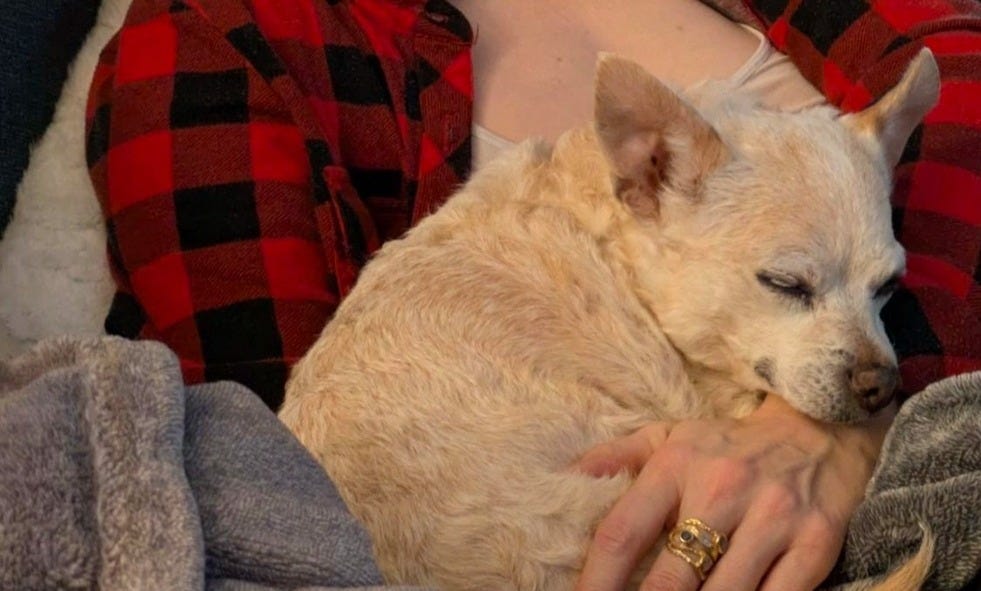
Still, I knew we were on borrowed time. It was easy to forget, once the two-year mark passed, because she was doing so well, but I forced myself to remember. Some people in my life thought this was masochistic, but I needed the visceral reminder that every day with her was a gift I shouldn’t take for granted.
It’s astonishing that we got so much time with her after the heart failure diagnosis, but when she went, it was fast and horrible. The heart medications had done a number on her kidneys, and they failed faster than we ever imagined. I’ll spare you the details. For context, the best part of that day was when I vomited on the side of a highway in Reno in 90-degree heat. Everything else that happened was exponentially worse.
Since we’ve gotten home, I’ve been wandering around my house, disoriented and dissociated, like a Victorian widow whose husband has been lost at sea. I walk in circles because it’s better than sitting, or at least my legs seem to think so. Every part of my body has a life of its own; I’m just a passive bystander along for the ride.
My brain seems to have dissolved into a kind of thick, gluey soup that subsumes my thoughts before they reach their destination. Every thought turns into vapor before I can harness it. It’s like walking into a room and forgetting what you were supposed to do there, only entirely inside your head. Countless times a day, I have to work backwards to find the thing I was thinking, like starting at the end of a maze on a cereal box and tracing my way back to the beginning.
And then I think I see her. She is the laundry basket in the corner of the room, she is the blanket on the couch, she is the shadow next to the door. She is the pillow at the foot of the bed, she is a curtain moving in the breeze. I speed on the way home from the grocery store because I’ve been gone too long and need to let her out to pee, and then I remember there is no hurry at all. This is the cruelest part, this tumbleweed of grief rolling through a ghost town, forgetting for a fraction of a second and then remembering over and over again.
That’s when my bones feel like they’ve turned to lead, and there’s nothing left to do but curl into a ball, pull a blanket over my head, and be glad that my brain is still a gluey soup because I don’t want the thoughts that will come.
I’m surprised that the thought of alcohol isn’t remotely tempting. Usually, big enough stress or sadness reflexively causes the thought of a drink to roll through my brain. Not in a real ‘I want or am going to drink way’ but because even 17 years after my last drink, I still have a Pavlovian desire to numb pain and discomfort. I’ve been waiting for the thought so I can acknowledge the instinct and remind myself I won’t be acting on it.
I didn’t think it was possible, but I think I’m too sad to even fantasize about the forbidden apple. I know what alcohol would do. The pieces of myself that I am barely holding together would burst, exploding into viscous blobs and leaden shards with no hope of repair.
So instead, I will sit here and miss her. I’ll remind myself that 15 years with a dog is an incredible gift, and that I am so grateful for every single day with her. And then I’ll miss her some more. Because she was mine and I was hers.
Want to support the newsletter without committing to a paid subscription? Leave a dollar or two in the tip jar via the link below.
Send questions and feedback to askasoberlady@gmail.com. By sending a question, you agree to let me reprint it in the newsletter with your name redacted or changed. Emails may be edited for length or clarity.
I’m not a doctor or mental health professional, so my advice shouldn’t be construed as medical or therapeutic. You are free to take or leave it.
Such a beautiful essay about a beautiful soul. Thank you for sharing this. Grief means you loved the best way possible.
I'm so sorry for your loss, Katie. It's so hard to lose a dog--they're the best, such sweet and wise companions, and it sounds like Sally was one of the all time greatest. Love to you.