

Why do they call it the past/oh when nothing’s passed?
-Sarah Harmer
When I got out of rehab, I was still—technically—dating the guy I’d been dating on my way into rehab; the poor, unfortunate soul whom I loved very much but had gotten together with at a time when my singular focus was drinking whilst pretending it wasn’t. Every moment of every day, I was either engaged in the “crime” (drinking) or the cover-up (lying/hiding evidence of said drinking). My commitment to the cause was deep and unrelenting; the sheer brazenness of my lies would have made Henry Kissinger proud.
So, it made sense that this guy needed to talk about all the ways I’d screwed with his head. For weeks, we talked and talked and talked. Eventually, as I started to build a sober life—one in which I wasn’t lying to everyone—I couldn’t talk about all the shitty things I’d done to him anymore. Understandably, he still needed to make sense of the chaos, but continuing to go through it with him started to feel like I was back in the muck of guilt and shame. I felt like I couldn’t move on to my new life because I still hadn’t been punished appropriately for my old one. I had to stop rehashing the past, or it would suffocate me. I was devastated about ending the relationship with him, but it also made me feel like I could finally breathe.
Watching the pilot episode of Feel Good brought me right back to that very bad feeling. But I’m getting ahead of myself.
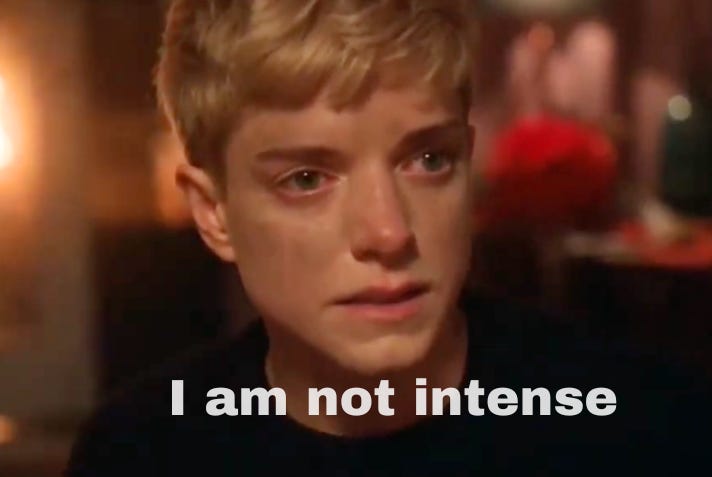
Mae (Mae Martin) is a stand-up comedian performing for tepid audiences in Manchester, England. In the opening scene, we see her do a set that only one person in the audience finds funny. We soon learn that the woman who found Mae so funny is a lovely brunette named George, and Mae is immediately taken with her. George has only dated men so far, but a short montage shows Mae changing that, and three months later, they’re moving in together.
The newly cohabiting couple is on a Skype call with Mae’s parents in Canada when Mae’s mom asks her if she’s found a new Narcotics Anonymous meeting.
(The “that’s why we’re not close/we’re not close??” exchange between Lisa Kudrow and Mae is when I knew I was fully sold on the show.)
It’s an interesting premise. When are you supposed to tell someone you’re dating that you’re sober because you have a history of addiction? I think it’s fair to say ‘before you move in with someone,’ but aside from that, it can be tricky.
In the olden times, when I was single and “internet dating” mostly meant going to a website and filling out a detailed profile, I used to put “I don’t drink, but I don’t care if you do,” as a very self-conscious, only partially accurate disclaimer. (The “I don’t care if you do” part was only true if the person in question drank moderately, but I digress...)
I was grateful to have a disclaimer, so I didn’t have to go through 7,000 explanations of “no, I don’t drink, yes it’s fine we’re at a bar,” but it also kind of sucked. I didn’t want to come with a disclaimer!
The difference between Mae and me, however, is that alcohol is ever-present in social settings. Most people aren’t openly-yet-casually doing cocaine on first dates (we learn later in the episode that Mae’s addiction was to cocaine). Mae’s “secret” is much easier to keep than a history of alcohol addiction.
I imagine for those in Mae’s position, it’s a blessing and a curse: you can withhold that information for as long as you want because circumstances are less likely to force your hand. But that also means you have to make an active, deliberate decision to do so, which can be even harder.
Mae’s hand may have been forced by her parents, but she’s still doing everything in her power to be as vague and slippery about the details of her addiction.
It’s a masterclass in conversational evasion. Answering “Yes” to “Six years? Six months? A week?” before immediately changing the subject is a hilariously dirtbag thing to do to someone you’re in a relationship with, but if you’ve ever been a dirtbag, you have to respect the skill involved.
AASL will always be free for anyone to read, but paying subscribers are the only way to keep the newsletter afloat; I could really use some help with that. If you can upgrade from a free to a paid subscription, please consider it. Either way, I’m happy you’re here!
To keep George happy(ish), Mae goes to an NA meeting (where the snacks are just eggs??), gets weirded out, and leaves early to drink 12 million cups of coffee with a woman she met there named Maggie.
This is when we know for sure Mae’s plan won’t end well. It’s no longer about when and how to tell George the details of her addiction, or if she’d benefit from attending NA meetings; it’s now clear that—completely independently of anything else—Mae can’t face her past.
But don’t worry, she’s making other great choices:
Mae, Mae, Mae, you sweet little nugget of pathological avoidance. From one weasel to another, “I used to have a problem, and now I have you!” isn’t how you convince someone you’re in a healthy place. Especially on the heels of “I don’t need meetings, but this weird lady is going to be my sponsor!”
Twelve-step programs aren’t for everyone, but a “sponsor” you meet up with to hang out instead of going to meetings is what most people call...a friend.
That’s right, Mae’s spin on Maggie’s sage wisdom of “take your past, shove it in a box, take that box and throw it in the bin, and flush that bin down the toilet,” is to light the box on fire. It’s understandable. It was a shitty period of your life, and you want it to be over. You need it to be over. You need to be a different person than you were when you did all those embarrassing, hurtful, sad, thoughtless things. It’s as natural as it is misguided.
For all the stilted, archaic language in AA’s Big Book, I love how it describes the relationship a person can have with their past after getting sober: “We will not regret the past nor wish to shut the door on it.” It’s a good goal for anyone.
It was also a concept that was unfathomable to me when I first got sober. I didn’t just want to shut the door on my past; my past was a haunted house—I wanted to shut the door and firebomb the place. Once that feeling passed, I went to the opposite extreme: I spent hours mentally going over every square inch of the house, reliving all the chaos I’d created when I was drinking. It felt like an appropriate punishment for building a house of horrors. But one day, I couldn’t do it anymore. I came to see that wallowing was as unhelpful as...putting the past in a box and flushing it down the toilet. My past could simply be my past.
Back to Mae and George: Mae goes to the comedy club, and George does karaoke elsewhere, and they both manage to hang out with what seem like insufferable human beings. Mae walks back to George’s and...
Well, it’s a start. We celebrate baby steps here.
*
If you enjoyed this post, please like, comment, or share it. This helps others find the newsletter!
Want to show your support of AASL without committing to a paid subscription? Leave a one-time tip here.
Send questions and feedback to askasoberlady@gmail.com. By sending a question, you agree to let me reprint it in the newsletter with your name redacted or changed. Emails may be edited for length or clarity.
I’m not a doctor or mental health professional, so my advice shouldn’t be construed as medical or therapeutic. You are free to take or leave it.
This is so incredibly timely. For me, I don't associate the reasons I did shitty things with drinking. I drank for many, many, many reasons, one of which was that I did shitty things I would rather not have looked at. Sure, drinking made it so very much easier and so very much more likely that I would do shitty things. It even made it so that the shitty things I did, I did even more shittily. But it wasn't WHY.
Doing steps 4 through 9 required that I be honest about that, decide to take different action, and then actually take that action. It was the most freeing thing I ever did, and I absolutely, under no circumstances, EVER, would have done it solely of my own accord, as my own idea.
That freedom alone would have been enough by far, but as a further miracle, I have discovered that the greatest gift of owning my past is the opportunity to help other people who are stuck in their actual shitty present, when it looks remarkably like my increasingly distant past.
And in this way I invite more love into my life.
Amazing.
I love when you cover my favorite TV shows and movies, but I REALLY love when you help me find a new show I think I'll love