

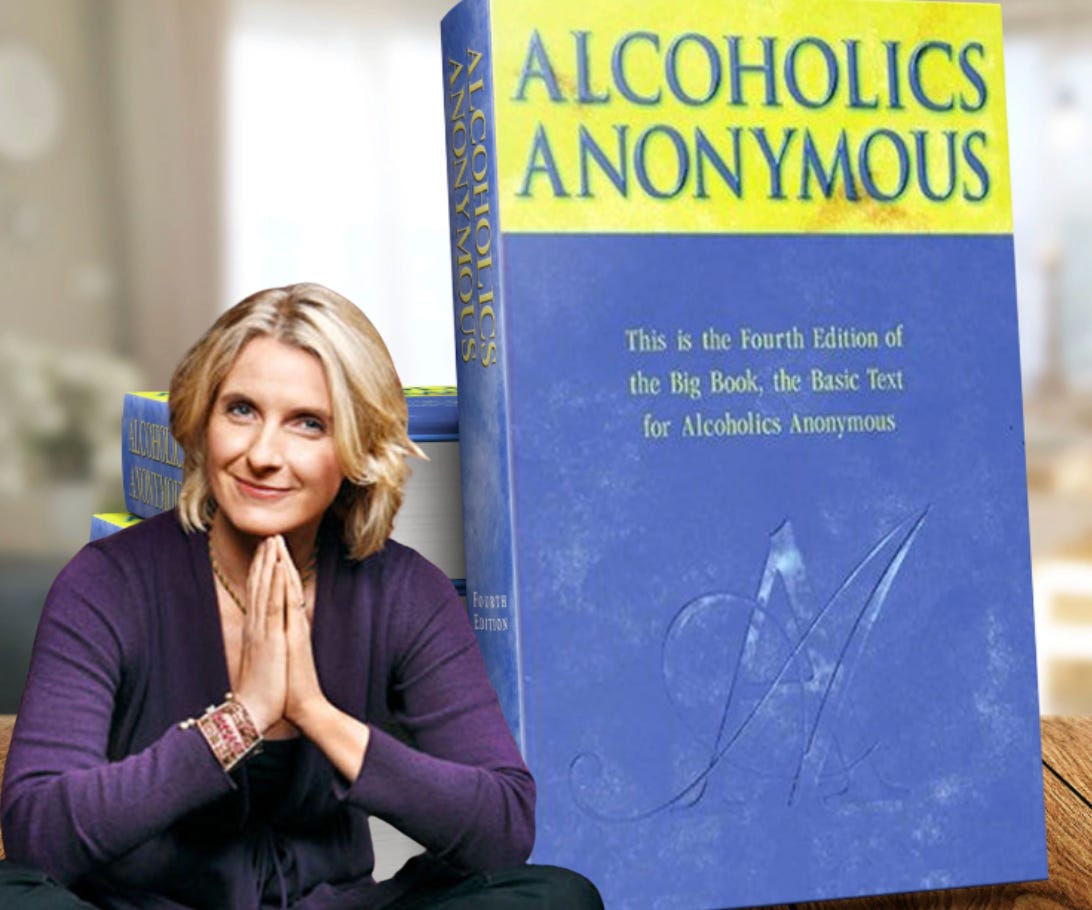
When I was about two-thirds of the way through Elizabeth Gilbert’s new memoir about addiction, recovery, and the death of her partner, Rayya, I told the friends who had been prodding me to read it that “Everyone should have to wait 10 years after getting sober before writing a recovery memoir.”
I am, of course, joking. People should write about their own lives whenever they feel inspired to do so. What makes sense to publish, however, is another matter entirely.
Like many people, I read the wild excerpt from Gilbert’s new book, All the Way to the River, published in The Cut, as well as Jia Tolentino’s excellent analysis of the memoir as a whole. The part everyone was talking about—Gilbert’s plan to murder her terminally ill partner, not out of mercy but a desire for Gilbert’s own pain to be over—didn’t seem like something I should weigh in on. Yes, it is horrifying to read that the woman who told us to Eat, Pray, and Love formulated a murder plan, but I’ve also never been the caregiver for my terminally ill, drug-using partner, so what do I know? More to the point, does anyone really need another hot take about that part of the story?
(If you want to read a good take about that part, I recommend this post by Mary Elizabeth Williams.)
Finally, I told my friends that I didn’t want to comment on a memoir I hadn’t read in its entirety. I wasn’t avoiding throwing my take into the roiling discourse around this controversial memoir; I was merely being a responsible commentator.
Then, mere hours later, my Libby (library) app let me know that “my” copy of the book was available to borrow. I have no memory of putting the book on hold, but there it was, waiting for me, excuses be damned. So, I spent yesterday reading the book from start to finish.
One last caveat before we get into the meat of what has been sold as a recovery memoir but is also very much an addiction/self-help manifesto: Because there’s been so much buzz and backlash (and backlash to the backlash) regarding this book, people may wonder what my relationship to Gilbert’s work was before reading this.
I read Eat Pray Love at some point, but I remember very little about it, other than the beginning involved a lot of pasta. One of her novels, The Signature of All Things, is phenomenal and made moss—moss of all things—genuinely fascinating. Until yesterday, those were the only two books by Gilbert I had read.
In All the Way to the River, Gilbert describes falling in love with her friend Rayya, Rayya’s cancer diagnosis and relapse into alcohol and drug use, and ultimately Gilbert’s own reckoning with her sex and love addiction and codependent tendencies. The disclosures are often brave, upsetting, and ethical minefields. They are also not what made the book feel frustratingly irresponsible.
Many people who get sober through twelve-step recovery—myself included—go through a period where they identify so strongly with the archetype of an addict as portrayed in the Big Book, that it becomes the explanation for every behavior, relationship, personality trait, not only in themselves, but in anyone else who claims the same label.
All the Way to the River is riddled with such characterizations; it strains under the weight of the reductive and often inaccurate statements about “addicts” (her word, not mine) and addiction. Below are a few examples, with my brief explanation of what I took issue with in italics.
“[A]ddicts cannot use any intoxicating substances without running the risk of relapse... full sobriety is a necessity for recovery.”
Sometimes true! Sometimes not. How are we defining “intoxicating substances?” Given that Gilbert repeatedly mentions Rayya using trazodone—a drug so safe and non-intoxicating that they let us take it in rehab— in the same breath as her cocaine and alcohol use, I don’t know that I’d consider Gilbert an authority on the subject.
“You can love an active addict, sure—but they can’t love you back.”
I think what she means to say is that someone with addiction will always put their addiction before the person or people they love—which is very often true—but “addicts” are not incapable of love.
“Image management is something addicts care a lot about.”
Sometimes! And sometimes they don’t. In the later stages of substance use disorder, people often really don’t give a shit about their image as long as their internal craving for their substance of choice is met.
“I became a vampire, which is something all active addicts eventually become.”
Keep the focus on yourself, girl! Stop calling other people vampires! Who does that help?
“That goes for all addicts...nothing can stop us but a miracle.”
If you ever feel the need to say “that goes for all addicts,” you should take a beat and think really hard about whether or not you’ve researched enough to make that kind of statement.
“Addicts don’t do well when they lose contact with a higher power—because then they start believing their own demented thinking is the most supreme intelligence in the universe and that’s never a good idea.”
This one is particularly ironic; I’ll leave it at that.
The list goes on. And I understand what she’s saying. If you had asked me in my first few years of sobriety, I might have made similar statements. One of the beautiful things about twelve-step programs is how you can go from feeling like a broken freak to complete belonging and acceptance among a group of people who identify with all the worst, scariest feelings and behaviors you’ve ever exhibited. It’s wonderful.
But there’s a difference between finding a program or methodology that resonates for you and the belief that everyone with the same problem will respond similarly. Not every person with addiction needs the same thing.
Once you dig into the issue a bit more, you start to realize that “addicts” are not a discrete class of egotists universally in need of a spiritual practice. Just as is the case with depression or anxiety, people with addiction often have overlapping symptoms, but the genesis of the condition, how it progresses, and the most effective treatment can vary widely among the individuals afflicted.
Gilbert has made the mistake that is easy to make in early recovery: She takes her experience of addiction and recovery and shapes it into a simplistic equation that never quite adds up to the universal truth she thinks it does.
Everyone has the right to write about their own experience, and what they choose to publish is a decision every writer needs to make for themselves. Memoir is a thorny and complicated endeavor. But the book isn’t just a memoir; it’s also a self-help book about recovery, and Gilbert makes it clear that she has neither the distance from her own traumatic addiction and recovery nor has she done enough research to justify the authority with which she discusses these issues.
For example, in the book, she characterizes the Oxford Group—the organization that served as inspiration for Bill Wilson and Alcoholics Anonymous—as a “collective of spiritually minded individuals” from “a variety of religious backgrounds.” In reality, the group’s mission was to be “living Christianity” that builds on the “accomplished work of Jesus Christ” as outlined in the New Testament. Wilson himself referred to the group as “aggressively evangelical” and cited this as a reason for his departure.
Similarly, she claims the Oxford Group had “no hierarchy,” despite Wilson explicitly stating this as a primary reason for his break with the group. He said, “The Oxford Group had attitudes and practices which added up to a highly coercive authority. This was exercised by ‘teams’ of older members. They would gather in meditation and receive specific guidance for the life conduct of newcomers. This guidance could cover all possible situations, from the most trivial to the most serious. If the directions so obtained were not followed, the enforcement machinery began to operate.”
This may seem nitpicky, but I don’t think it is. You don’t need to know the history of the Oxford Group and Alcoholics Anonymous to write a recovery memoir, but that knowledge should be a prerequisite for publishing a book that discusses the history of the Oxford Group and Alcoholics Anonymous.
The great irony of the addiction recovery aspect of Gilbert’s book is how often she emphasizes the need for humility while explaining that five years of sobriety from her sex and love addiction has made her an expert in ‘addict’ behavior and recovery.
The result is that even the good points she makes about addiction are tainted by the unearned authority with which she articulates them. I imagine it’s challenging to have people across the world consider you a self-help guru and then write a memoir about getting sober without feeling like you need to be an endless fountain of recovery wisdom. But for all of the radical honesty she espouses in the book, the most radical act would have been to resist the urge to write beyond her knowledge and experience.
If you enjoyed this post, please like, comment, or share it. Doing so helps others find the newsletter!
Send questions and feedback to askasoberlady@gmail.com. By sending a question, you agree to let me reprint it in the newsletter with your name redacted or changed. Emails may be edited for length or clarity.
I’m not a doctor or mental health professional, so my advice shouldn’t be construed as medical or therapeutic. You are free to take or leave it.
30+ years have taught me that I know nothing. 😉
As a recovering alcoholic (2/2/84), I have learned that I can share *my* experience with drinking, drugging, recovery. Period. I can’t speak for other alcoholics. Although we have similarities in our experiences, it is not cookie-cutter identical. If I use the word “we,” it is meant to identify & qualify — not assume my experience is your experience (in either drinking/using or recovery). And I do simply share my experience— any strength or hope is what the listener leaves with (and that, too, will vary depending upon the listener’s experience). Thanks for letting me share. ☮️🙏🏼❤️