

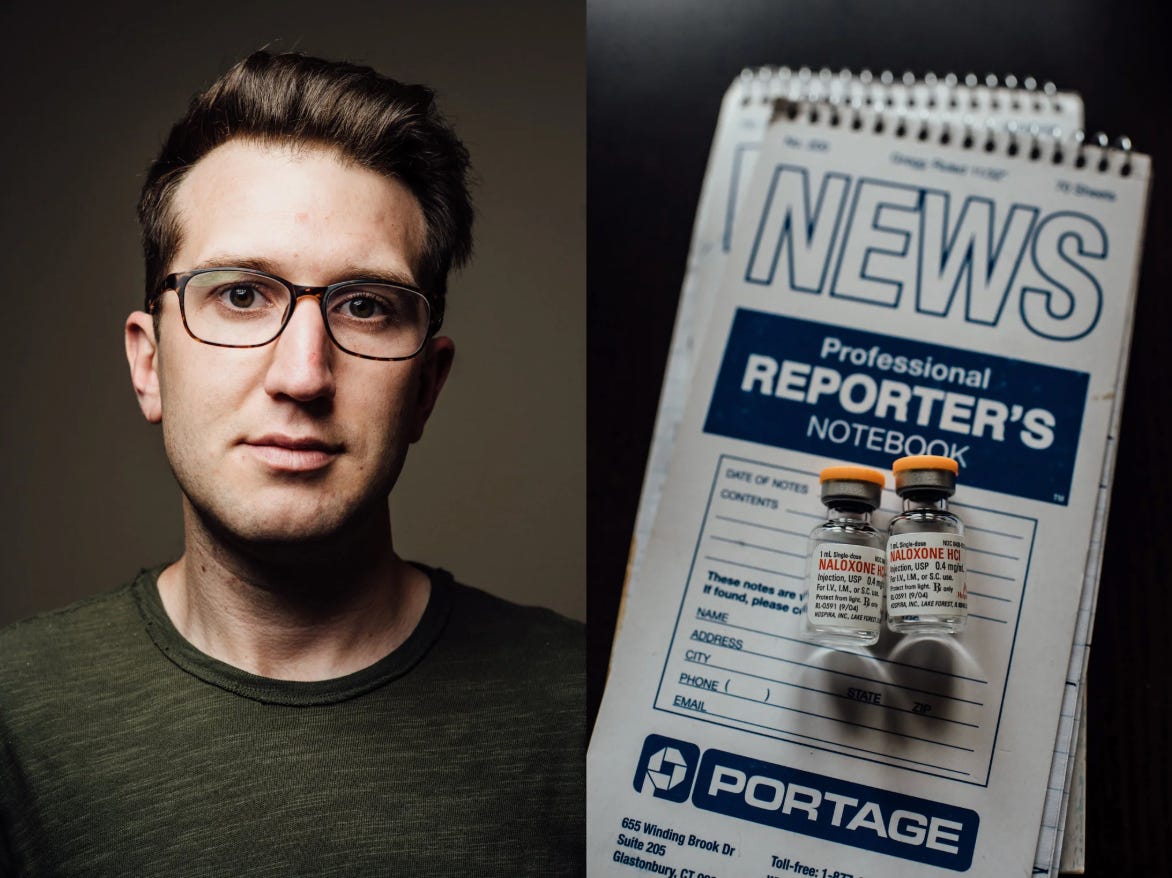
When I decided to add an interview component to AASL, I knew immediately that Zach Siegel was at the very top of my interviewee wish list. Zach and I got into the freelance writing game around the same time, and we both had a personal and professional interest in substance use and addiction recovery. We routinely crossed (virtual) paths writing for the same niche addiction-recovery-centric publications (RIP The Fix, Substance, etc.).
As you’ll read in the interview, he has his own history with substance use and treatment; he’s also a brilliant journalist and researcher who has spent much of the last decade reporting on ineffectual and harmful drug policies, how the U.S.’s broken healthcare system further marginalizes people who use drugs, and the systemic shifts required to produce meaningful change.
We talked for a long time (which was incredibly nice of him, considering he has a one-year-old and is perpetually sleep deprived). It’s on the longer side (there was so much I didn’t want to cut!). I’ve included subject headings to break up the text and make it easier to navigate.
Katie: Zach! I can’t believe we’ve known each other for so long, and we’ve never talked about our various addiction recovery stories. You’ve written a little about it in some of your work, but not a ton.
Zach: Yeah, I definitely know more about yours because of your more memoiristic pieces. I’ve never really written about my story in depth.
KM: Why not? Did you ever want to?
ZS: Over the years, I’ve written some memoir-style pages about it, but it was just so dull. Nothing exciting happened. I was just very alone and tethered to opioids. That was it.
Eventually, I realized that the consequences weren’t as dire as they are for some because I had a safety net, a supportive family, access to quality healthcare; structurally, I could only fall so far until I was caught.
The way my life was structured almost determined the fact that I wasn’t going to go to prison, that I was going to go to a fancy rehab. I got so many chances, a lot of luxurious introspection to wonder ‘why am I like this?’ That is a way through addiction and recovery that is not afforded to a lot of people.
As I began to study this and learned how harsh the US healthcare system is and how brutal the economics of life are. The more I thought about my story, I realized, ‘I don’t need to write a book about how this nice Jewish boy from Chicago had a bad time.’
KM: Extremely fair. But what did being alone and being tethered to opioids look like for you?
ZS: I had just turned 22 years old and had completely buried myself in opioid addiction. I was living alone in an apartment in Denver, with a TV, a futon, and a stack of newspapers, books, and movies.
I watched movies and read things in this weird, half-awake, half-not-awake, opioid lull. I’d have to close one eye to stop seeing double, so I could keep reading.
That was what my life looked like. Dull.
An early 2000s story
KM: Tell me a little about how you ended up in that apartment.
ZS: I was in a high school north of Chicago that had over 4,000 kids. My graduating class had 1200 students; it was massive. I learned to get by in that setting by flying under the radar. My way of being in the world was to not call attention to myself, to not vocalize needs, and really just kind of be a fly on the wall.
This was in the early 2000s, and at that time, there was a pharmaceutical bonanza—it was near the peak of an incredibly loose, unregulated pharmaceutical industrial complex. Great healthcare, affluence, access to doctors, and our parents’ medicine cabinets fed our addiction. It created a whole economy of benzos, opioids, and the more exotic pharmaceuticals.
Freshman year, I started smoking weed and drinking; very quickly, I was introduced to all sorts of other drugs. Opioids were in high circulation at this time; the most expensive and sought-after pharmaceutical was OxyContin, which was being liberally prescribed.
The feeling opioids gave me was so alluring. I could do small talk. I could be confident. I wasn’t wracked by nagging anxieties and neuroses...that all dissolved away, and I was left with, Oh, I’m happy. I feel great. I have energy.
I know that goes against the stereotypes of opioid use, but for some combination of my environment, psychology, and genetics, I had a kind of lock-and-key relationship with opiates. I found the thing that worked.
KM: Isn’t it funny how that happens? It was the same thing for me and alcohol. Right away, it was like ‘bam, you have found the solution to being Katie.’
ZS: A hundred percent. I tried all the other “very addictive” drugs and did not like most of them. I couldn’t really see myself getting addicted to them. But by my senior year of high school, I had figured out that opioids worked for me and, almost thoughtlessly, slid into constant use because it was such a good fit.
Psychodynamic Therapy
KM: And for whatever reason, we needed something to fit.
ZS: My mode of recovery has been one-on-one, intense psychodynamic therapy, so I have come to understand a lot of this through a psychodynamic lens. To sum it up in a way that’s not too jargony: Your relationships teach you how to be a person. Who are your parents? Who are your siblings? What sibling order are you? These things matter. So I view addiction through a developmental and relational perspective. I know that’s not everyone’s cup of tea, and it’s very cliché—the Jewish kid loves psychoanalysis.
KM: Sibling order is an interesting one. I’m the youngest of two, and there are a lot of patterns I see among the youngest and oldest siblings. Often, the older sibling loves rules and exceeding expectations, and the younger, myself included, grows up with a kind of ‘rules were made to be broken’ perspective.
ZS: I’m the youngest of three; I have an older brother and an older sister. As a young boy, I came into the family and felt like the train had left the station. I wasn’t the center of gravity like the first child, and I didn’t shape the family like the second child. The car was speeding down the highway, and I had to jump into it.
If I needed a great big, warm hug, I knew that an opiate was going to produce that effect 100% of the time when I could not find it elsewhere.
I learned not to need anything or to vocalize the needs I did have. I learned that to get my needs met, I had to fight for them or engage in subterfuge. That had a lot to do with how I came to relate to substances. Like, if I needed a great big, warm hug, I knew that an opiate was going to produce that effect 100% of the time when I could not find it elsewhere.
KM: I was always getting in trouble for reasons I didn’t understand—it felt the whole world was playing a game and I was too dumb to figure out the rules. And that feeling of insecurity and stupidity absolutely shaped my relationship to alcohol. You know what makes you feel confident and smart and like you’re winning at the game of life? Vodka.
ZS: We all find our source.
KM: We all find our source. So, you found yours in high school; what happened when you graduated?
ZS: I moved to Colorado, ostensibly to go to college. At some point, I was back in Chicago, and it was obvious that I was unwell. I’ve always been kind of skinny and underweight, which didn’t help, but I was very emaciated. My mom is a nurse, and by that point, she knew what opioid addiction looked like.
Being so close to the city also meant being near behavioral health hospitals, and she got me into one. Resources and access to help were readily available to me.
In the hospital, they had a detox wing; I was put on antidepressants, Seroquel, and Suboxone.
The polarized world of addiction treatment
KM: What was the hospital like?
ZS: This is where things get interesting for me and probably ties into why I got into journalism. In the hospital, I started to understand that there’s this very strange, polarized world of addiction treatment. On the one hand, I’m talking to nurse practitioners, psychiatrists, social workers, and case managers, and I am prescribed medication. They’re stabilizing me. This is very much a medical event.
On the other hand, there’s this other kind of quasi-clinical, paraprofessional world of addiction treatment that’s outside of what we consider establishment healthcare and medicine. The detox place hands me a sheet of paper and says, “We recommend you get treatment after this. Here’s a list; we highly recommend you attend one of the programs for young people.”
KM: And did you?
ZS: Yes. There’s a very popular program called Gateway Foundation; they have a program I describe as a summer camp for kids who are mandated to attend through drug court. The first day, I learned that I was one of two people who were not court-mandated to be there. Everyone else lived there in what felt like an incarcerated setting.
My intake at that place was bizarre. I went through a long interview with them, and then this well-intentioned old lady asked what prescriptions I take. When I told her the medications I was on—which at that time included 12 milligrams a day of buprenorphine—she scoffed and said, ‘That’s way too high. You need to get off that.’
I was like ‘what are you talking about?’ Not only was I not living there, but this was medication that actual doctors in a hospital had prescribed me. That’s when it dawned on me that this place is operating in a framework that is really, really intense.
Then I’m told there’s a time in the program where I’ll be sitting in the “hot seat” where the group will hurl just criticism and beratement at me. I sat through one on my first day. Everyone is using this 12-step language I don’t understand.
When my mom picked me up from ‘camp’ that first day, I was like, ‘This is not the place. This is nuts.’
Her first response was to think I was an addict in denial, and I had to explain that no, I really wanted to get better and was feeling good, but this place was not it.
I ended up at Hazelden in the city, which is a more buttoned-up clinical operation with licensed counselors, psychologists, and doctors—stuff that felt more real to me than Gateway, where, between group therapy, kids play basketball and spades, like they’re in prison or something.
KM: Did Hazelden encourage you to do 12-step stuff?
ZS: Yeah, it was 12-step facilitation. There are parts of the 12 steps that I think are really on point for helping people—not just people with addiction—but everyone. But I’m not good in groups. I said [Gateway] was like camp, that’s because the idea of camp is hell to me. I can have friction with people in groups; I come off as terse or blunt and am vocally skeptical of most things. I have friends, but I don’t get friendships through my winning personality.
I really tried, but between the meetings and the literature, which I felt had a pretty clear evangelical Christian tone, it was tough.
KM: I’ve always thought that it was strange that I didn’t struggle with the God stuff more. Maybe it’s because the people in my home group were very much into a higher power being whatever you want, but for some reason, the more overtly religious stuff didn’t bother me, despite not being a religious person.
I’m a tiny speck in a giant machine, and there’s a lot going on that I don’t control or understand, so all I can do is try my best every day and feel my way around as best I can.
ZS: I always appreciated the people who defined their higher power as the group conscience, or the wisdom of the people in the room. I understand that. I certainly don’t think I’m the highest authority on anything. I’m a tiny speck in a giant machine, and there’s a lot going on that I don’t control or understand, so all I can do is try my best every day and try to feel my way around as best I can.
KM: Yeah, that’s why I think of a higher power as nature. Because I’ll go out and watch birds and animals and all of this life, and it’s like...none of them give a shit about me. This whole world is not about me.
Post-Recovery Recovery
KM: How do you think about recovery now?
ZS: I don’t have a strong recovery identity. People who know me know I’ve had a history of opioid addiction, and at present, I don’t identify as having addiction looming in my life. It’s not something I think about day to day.
After eight years of intense psychodynamic therapy, I understand that I have some obsessive-compulsive tendencies, and I appreciate that I need to sublimate that into something good and positive.
My addiction is like having this really intense drive that can be channeled toward something positive or destructive. It’s taken many years of therapy to get to the point where I understand myself, and I understand my relationships.
You have to decide what recovery looks like for you. For me, it’s doing exactly what I’m doing. I have a family, I have a partner, and I wake up knowing who I am. I just don’t have an attachment to a recovery identity.
KM: That makes sense. You said at the beginning that you’re interested in the systems at play—is there anything else you want to say about that? Like you, privilege kept me from facing certain consequences. The only reason I didn’t land in jail at some point was that I was a little white girl who went to a prep school—there’s no other reason.
ZS: I have hilarious stories about encountering the Chicago Police Department on the west side of Chicago, where they look me up and down, they see the address on my license, and say, ‘Get a load of this. Look at this kid. Wait till the captain hears about this one,’ and then they just let me go.
It’s humbling. I did not get out of this because I’m smart, clever, or have some elaborate system for getting away with everything. And I don’t feel guilty about it, I feel lucky. It makes it so clear that this is possible—we can treat people better.
What if everyone’s first experience with treatment was when they walked through the doors of a behavioral health hospital, and they got medicine right away? Way more people would be moving through treatment. It is an absolute joke how things currently work, and we as a country are utterly abysmal at treating this specific condition with any rational approach.
KM: People always say that addiction is the great equalizer, which is true, but recovery can be very discriminatory.
ZS: I totally agree. I’ve covered so much drug policy and, at the end of the day, I feel like I’ve scratched at bedrock—that my nails are bloodied. I have written the same sentence about needing to treat addiction humanely, needing to get people health care, needing to prescribe medication, needing insurance to actually cover therapy.
I am blue in the face saying all this stuff, and I am not a rocket scientist. The system we have and its outcomes are utterly atrocious. There are obvious things to do to improve it, and we’re not doing them. That speaks to a much greater stagnation in the country that we live in, where basic problems can’t get fixed.
That’s where I am today—trying to understand why things don’t change. I don’t think there’s a mechanism for repair that is in any way proportionate to the scale of what’s broken.
As I said, I have a lot of friends. Everyone loves my bubbly perspective and winning outlook on life.
Read Zach’s work here.
*
If you enjoyed this post, please like, comment, or share it. Doing so helps others find the newsletter!
Want to support my work without committing to a paid subscription? Leave a tip.
Send questions and feedback to askasoberlady@gmail.com. By sending a question, you agree to let me reprint it in the newsletter with your name redacted or changed. Emails may be edited for length or clarity.
I’m not a doctor or mental health professional, so my advice shouldn’t be construed as medical or therapeutic. You are free to take or leave it.
Thanks for this, Katie. I always feel your writing is on point, and such interviews add and enhance your perspective.
I loved reading both of your viewpoints. I was primarily into alcohol and pot. About the last third of my using were mainly alone. I didn’t notice being lonely until I got sober. I’ve received therapy in sobriety and had a dynamic counselor for most of those years. Again, I appreciate what each of you shared.