


A few weeks ago, an acquaintance who, like me, got sober through AA and had decades of sobriety but hadn’t been involved in twelve-step groups for years, told me that she was drinking again.
It began as an accident—she was out with friends, and the bartender missed the “non-alcoholic” part of her order. My acquaintance, let’s call her Sue, took a sip and, because it was some fruity concoction, didn’t realize it was alcoholic until she was about halfway through, when she began to feel the effects of the booze she couldn’t taste. (She gave it to a friend to finish.)
Hesitantly, she told me that since the fruity cocktail night, she’s had maybe five drinks over three months and never more than one on any given day. She explained that her reluctance to tell me this wasn’t because she thought I would judge her, but because she knew my brain would immediately do exactly what it did: reflexively wonder if the same could be true for me.
Both she and I “grew up” in AA, albeit in different locations. Throughout the first years of our sobriety, AA seared into our brains the idea that “No real alcoholic ever gains control [over their drinking]...there is no such thing as making a normal drinker out of an alcoholic.”
Those statements are, of course, an oversimplification. Nothing is true for everyone with (or in recovery from) alcohol addiction. People with varying degrees of alcohol use disorder can have wildly different outcomes for countless reasons. That diversity of experience is one reason I don’t doubt the accuracy of Sue’s story.
“I really don’t want to tell people in recovery,” she said. “And I would never tell anyone in their first few years of recovery. I’ve seen way more people fall right back into addiction than I have people who picked up and were fine.”
I nodded, half-listening while my brain did its little *maybe this could be you* dance. She had 25 years of sobriety when she sipped her non-mocktail; I have 18. Being so far away from the endlessly challenging months and years of early recovery is a blessing and a (much smaller) curse.
For one thing, it feels sort of embarrassing to continually find substance use and addiction so fascinating when my lived experience with it was nearly two decades ago. It’s the kind of thing that prompts snarky internet trolls to claim that I’ve “made recovery my whole personality.” (I find such comments rude only because I’ve also made being weirdly obsessed with animals a significant part of my personality.)
More importantly, it makes the maybe it was just a phase thought all the more enticing. Maybe Sue just needed a 25-year break. And if that’s true, maybe it means I just needed an 18-year break.
All of this swirled through my head in a matter of seconds, before I stopped and thought about what Sue was actually saying. Five drinks in three months?! That sounds like hell on earth. And that’s when I remembered why I always felt like AA’s claim that “there is no such thing as making a normal drinker out of an alcoholic” is definitely true for me, even if it’s not for everyone.
I have, quite literally, never been a normal drinker. I’ve never had any desire to be one. Stopping at one drink would feel like getting a crumb of my favorite dessert—just enough to remember how good it tastes, far less than could ever be satisfying. I’ve absolutely wished that I could drink less problematically. I’d love to be able to stop after getting to the sweet spot between very tipsy and moderately drunk, but stopping while I could still legally drive a car? Never.
Worse, even if I were able to stop at the sweet, tipsy-drunk nexus, there’s no situation in which I wouldn’t want to be there. Morning, noon, and night, I’d be hunting that feeling. The certainty of this knowledge isn’t the product of twelve-step indoctrination; it’s the fact that I knew as early as eighth grade that alcohol unlocked in me a dangerous, bottomless need for more.
My conversation with Sue did make me wonder, as I have so many times in the past, why I’m not one of the people who—through AA or other means—had the desire to drink disappear after a certain amount of time. I’m thrilled for the people in recovery who say they no longer miss alcohol or fantasize about having a drink or twelve, but in the words of the great Bob Dylan, “it ain’t me, babe.”
Maybe the reason 18 years hadn’t inoculated me from the instinct to drink myself into oblivion is that there’s something broken inside me that I haven’t fixed. Maybe it’s just how I’m wired. Probably, it’s a bit of both. Regardless, neither makes picking up a drink a good idea.
I was thinking about this a few days ago, when a friend sent me a clip of Shia LaBeouf’s interview in the wake of his multiple arrests for battery over Mardi Gras. The actor has a long history of substance misuse and violence that I have no desire to rehash here. In the interview, LaBeouf says, “I don’t think I have a drinking problem. I think I have a different problem…I think I have a small man complex. I think it’s something that has to do with anger and ego more than my drinking.”
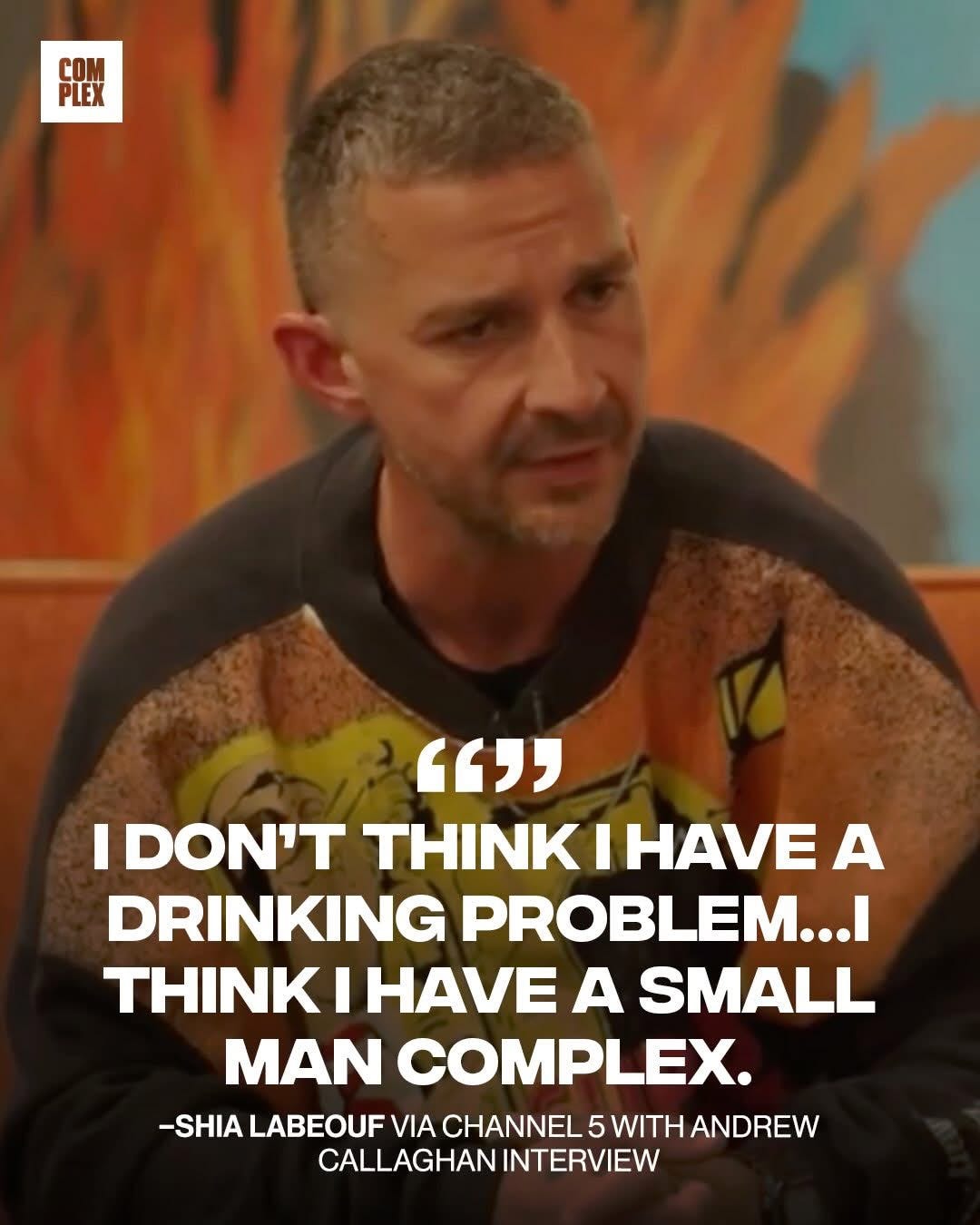
I have no idea if LaBeouf’s issues are the result of alcohol use, ego, anger, a small man complex, or anything else. We all contain fucked up multitudes. The problem comes when you dismiss one because you believe it’s only a symptom of the other. How many times did I say “I don’t have a drinking problem, I’m just depressed or traumatized or anxious” without interrogating the fact that—while I was indeed those things—my ‘solution’ only made them worse? Why didn’t knowing that drinking only made them worse stop me from doing it again and again? Why did I think having an underlying issue negated the reality of my alcohol use (or absolved me of its consequences)?
For drinkers like me, this is one of alcohol’s cleverest tricks. It cranks up whatever misery or mania lurks inside you while simultaneously obscuring any true self-reflection. It runs on hyperbole and vibes, never logic. If the way you deal with your anger issues is to get wasted and punch people, you probably do have an anger problem, but it’s being aided and abetted by your substance use.
I believe Sue when she says her drinking is not a problem. It makes me nervous, but I believe her. She has 25 years of sober self-reflection—who am I to question what’s right for her? Wherever she was two and a half decades ago, she’s not there anymore, and for her, right now, that’s good enough.
If you are actively drinking, however, that sober self-reflection is really hard to come by. If you’re fresh out of the drunk tank with a battery charge, I’m going to gently suggest that you might need a little outside assistance to see things clearly. One thing I know to be absolutely, infuriatingly true is that nothing about my emotional state is going to improve if I toss alcohol—the world’s biggest chaos agent into the mix.
Substance use and emotional issues are often a messy tangle of threads that can be nearly impossible to separate. They push and pull against each other, hype each other up, and shove each other down. If 18 years of sobriety has taught me anything, it’s this: as long as the notion of disappearing into a bottle feels like the answer to my problems, it will never actually be one.
If you enjoyed this post, please like, comment, or share it. Doing so helps others find the newsletter!
Want to support my work without committing to a paid subscription? Leave a tip.
Send questions and feedback to askasoberlady@gmail.com. By sending a question, you agree to let me reprint it in the newsletter with your name redacted or changed. Emails may be edited for length or clarity.
I’m not a doctor or mental health professional, so my advice shouldn’t be construed as medical or therapeutic. You are free to take or leave it.
As ever, I love the clear-headedness of this. I have 12 years and it’s extremely rare nowadays for me to have any desire to drink for pleasure. But I do still sometimes get the impulse to knock myself out with alcohol, which was all I used it for by the end, compulsively, and though I don’t literally know what would happen if I drank (I can’t read the future), even the slightest chance that I might be back in that place, deliberately knocking myself out several times a day, is simply not a risk I am willing to take.
I lost the ability to control AND enjoy my drinking over 30yrs ago. I never had “just one” drink and I don’t see that happening if I drank again. Sobriety has given me a wonderful life and there’s just too much to lose. I hope your friend can “drink like a normal person” but in my experience most return to problem drinking and loss of control with time. I’d rather live my life in the 12 step program, thinking I’m an alcoholic and being wrong, then drinking and trying to prove I’m not an alcoholic 🙏🏻🙏🏻🙏🏻