

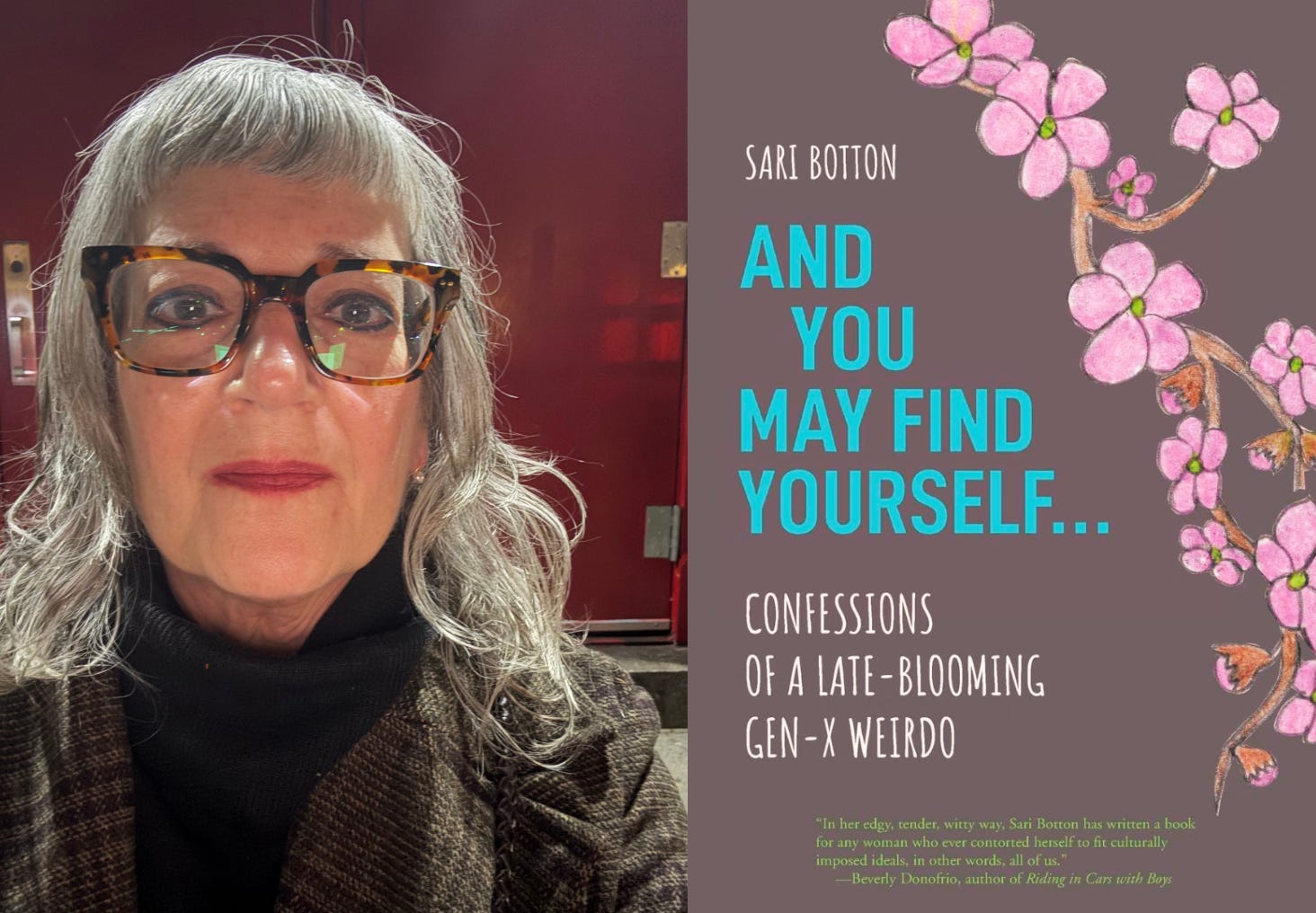
I met Sari Botton in 2018, when she edited an essay I wrote for Longreads, and I’ve followed and admired her work ever since. If you’re unfamiliar with her, she created three of Substack’s best publications: Memoirland, Oldster, and Adventures in Journalism. She’s also the author of the memoir, And You May Find Yourself, and the editor of two bestselling anthologies: Goodbye to All That and Never Can Say Goodbye. She is endlessly cool and frighteningly busy, so I’m incredibly grateful she made time for this interview.
Katie: Hi Sari! We’ve worked together before and known each other online for years, but I only know bits and pieces of your relationship to addiction recovery. What can you tell me about it?
Sari Botton: I’m reluctant to call myself sober because I haven’t really done the work. I don’t drink, but it’s mostly because, in menopause, alcohol gives me migraines. I also was never much of a drinker. I never had a very high tolerance, so when I did drink, I drank very little. But I also went through periods where I didn’t drink in support of alcoholic boyfriends, which is what I was addicted to.
I was an addict addict. My maternal grandfather was an alcoholic. I was very close to him when I was small, and as a teenager, I worked for him. Part of my job was pouring scotch. He was a little bit lecherous with me, and I’ve also written about how the smell of scotch on his breath became addictive to me. I have an essay in my memoir called “The Sweet Smell of Excess,” and it’s about being addicted to alcohol not by mouth but by nose, particularly on the breath of a difficult man.
KM: So your first exposure to the complicated relationship with an alcoholic was through your grandfather, but when was the first time you engaged with recovery in any way?
SB: In the early 90s. I was in my late 20s, and I was divorced. I had gotten married too young. I got married at 23 and left at 26. So I was single at 27, and I immediately got involved with alcoholics and addicts, and brought them to AA meetings.
I went to Al-Anon and CODA in my 30s, and I also dragged my alcoholic and drug addicted boyfriends to AA meetings and sat there holding their hands. I was the best girlfriend. I was gonna fix them. My love was gonna fix them. I eventually saw the error of my ways, but it was hard to learn. It was really hard to accept that I was diverting my attention from myself and my issues. I had to get myself good and hurt before I could walk away.
KM: Was there a specific incident that led to that realization?
SB: My first addict was also my last addict. We met in childhood and reconnected years later. He was the first addict in my life that I had a romantic relationship with, and he was in and out of my life for many years. It always ended the same way—either he would cheat on me, or he would hit me. He had a really hard time getting sober. When he got a little time under his belt, things were mostly great. Then, he would lose his ability to stay sober, or, even when sober, he would be violent toward me.
After not speaking for five years, he came back and promised that he’d be sober. It was the whole “I can’t lose you again.” It was like this huge romantic moment. Then he did everything he did before. He hit me. He cheated on me. He lied to me. He was mean to me. All the things. But it was like the grand-finale fireworks level of everything that came before. It was relentless. I got so badly burned.
For a long time afterward, I questioned why I went back to him. I know now why I needed to. It’s because I could have spent the rest of my life wondering if it could have worked out. I was always harboring these romantic notions that maybe, under the right conditions, at the right time, it could be amazing—that’s what it seemed like at first when we reconnected. Then it went so badly, and I was a wreck. So he did me a favor, because I don’t harbor a single molecule of desire, hopefulness, wistfulness, or nostalgia. He did me a favor, and I did myself a favor by going back to find what I needed to find out. It was an education.
After that, I went through this period of, like, ‘I’m only going to date sober addicts; addicts in recovery.’ After almost exclusively dating active addicts, I was like, I’m going to date addicts in recovery because they know things. It was not any easier. It was surprisingly difficult.
Don’t get me wrong, if God forbid something happened to my husband, I wouldn’t refuse to date people in recovery or anything. But at the time, it was almost like I was fetishizing people in recovery—I knew they’d been through some shit and was specifically attracted to that.
KM: You had the ‘They’re wounded, and I can heal them’ thing?
SB: I absolutely had that. That was a primary motivator for me in relationships.
Then, I realized that I had a problem and started going to CODA and Al-Anon meetings on my own, partly because I couldn’t afford therapy. I was like, “Oh, I’ll do this instead.” But I wasn’t getting better; it was hard for me to be in those rooms, hear everyone’s stories, and set boundaries for myself. I would hear people sharing about things I had been through, and who were still really struggling. It made me more depressed.
Eventually I got this amazing therapist who was in recovery, and he was like, “I would like you out of the rooms.” He said, “There is way too much transference in there, and you are a radio receiver for everyone else’s emotions; you don’t know what your emotions are and what theirs are.” So, I stopped going.
I’m not saying the [Al-Anon and CODA] rooms are bad for everybody, but they were for me at the time, so my therapist encouraged me to leave.
KM: That is a good therapist. I feel like some therapists tend to recommend things almost on autopilot—like “You have this problem, so go do this,” without really considering the person and their situation.
SB: It was really hard for me to establish boundaries with sponsors and sponsees. I had a hard time solidifying who I was and what I felt. I had such porous boundaries for so long, especially dating active alcoholics and addicts. It was hard for me to be sure what was my issue and what was somebody else’s, so it was useful to get out of the rooms, though I’m glad I have some experience with them.
KM: You still got something out of your experience?
SB: I met people who had gone to even more extremes than I had. I met a woman who had been hospitalized multiple times for codependency. Her codependency had led her to be with such horrible people who would do such horrible things to her that she wound up in the hospital. Ultimately, she had to go to an inpatient facility for 90 days because of codependency.
KM: Damn.
SB: Yeah, it was a reality check for me.
KM: I imagine it was also a reminder that codependency is very real. I think sometimes it’s easy to brush off addictions that aren’t substance-related because they’re not quite as tangible. But it doesn’t make them any less real.
SB: Exactly.
KM: So, you kept working with the therapist?
SB: Yes, he was great. I’d walk in there and go, “You’re not going to believe it; I went after the wrong guy again.”
He would say, “Don’t be embarrassed. This is a laboratory. You’re going to come in here, tell me what you’re doing, and we’re going to examine it without judgment, like a science project. Why are you doing this? What does it mean to you? What would happen if you didn’t do this?”
I was addicted to the idea of fixing somebody. I was addicted to the bad behavior that would turn around and surprise me and be good and then be bad again. I was addicted to that rollercoaster of intermittent gratification.
Progressively over the next couple of years, I started going after one more reasonable, kind, workable guy after another. I moved into a healthier trajectory. I’ve now been married to my husband for 21 years.
KM: That’s great.
SB: Yeah, and it’s not like I’m fixed. I still do too many things for people; I’m still a people pleaser.
KM: Eh, who is fixed, really?
SB: I know there’s no such thing as being fixed, but I’m grateful I no longer feel the need to...try to fix people. I have friends who are in recovery, and they’re great. Their recovery is their business, not mine. I have no interest in engaging with them over it, unless they want to ask me something or tell me something. It’s just not what I’m there for, and that has been a real relief.
KM: Last question: How did the partnership between Oldster and The Small Bow happen?
SB: Well, I stopped drinking in 2018; again, it was because alcohol was giving me headaches. Halfway through one glass of wine, I would start to feel hungover. It could be a combination of things. It could be related to menopause and aging because there’s less water in your muscles. I also have a lot of autoimmune stuff, and it could be histamines or whatever. But in any case, even though I wasn’t an alcoholic and was never a big drinker, I still felt peer pressure to drink. I would go out and say to people, “I’m not drinking,” and they’d pour me a glass of wine. I’d end up thinking, “Oh, I should just drink it,” and end up with a headache.
Then, I read Edith Zimmerman’s illustrated essay about getting sober, and I thought it was brilliant. She said that one of the things that helped her was Alan Carr’s book on quitting drinking, and so I got myself that book because even though I didn’t want to drink, I didn’t like drinking; even though it was harder for me to drink than not drink, I couldn’t say no. I couldn’t shore up my boundaries around it, and so I got that book. It really helped. Instead of saying “I’m not drinking,” I now say to people, “I don’t drink.” That very subtle phrasing makes such a difference.
Edith’s work drew me to The Small Bow, and I started reading it religiously; I came to admire AJ. We had some mutual friends and had written about some of the same topics, and he reached out to me. I was shocked to see his name in my email inbox because he was like a god to me at that point. I was so impressed by how he turned his life around and wrote so beautifully and humbly about addiction. He told me that he loves Oldster and the Oldster questionnaire and asked if he could take it. I said yes.
After it was published, someone who writes for Oldster read AJ’s questionnaire and was so moved by it that he signed up for The Small Bow. He started corresponding with AJ, and then AJ interviewed him for The Small Bow about his sobriety, and it was really good. So I said to AJ, “What if we did a series of these? What if we collaborated? Oldster is focused on one kind of longevity, and The Small Bow is focused on a different kind of longevity—longevity of sobriety versus longevity of life. We could do a crossover. He loved the idea, and we’ve been doing it monthly ever since.
*
If you enjoyed this post, please like, comment, or share it. This helps others find the newsletter!
Want to show your support of AASL without committing to a paid subscription? Leave a one-time tip here.
Send questions and feedback to askasoberlady@gmail.com. By sending a question, you agree to let me reprint it in the newsletter with your name redacted or changed. Emails may be edited for length or clarity.
I’m not a doctor or mental health professional, so my advice shouldn’t be construed as medical or therapeutic. You are free to take or leave it.
I appreciate how you highlight that everyone is different, and so are their paths and motivations. We get lumped together and measured against an accepted definition of “normal.” I have learned to be way less judgmental in recovery, both of others and myself. I really like the quote from the therapist: “we’re going to examine it without judgment, like a science project.”
The therapist's line about being a radio receiver for everyone else's emotions hit me hard. So many of us in the family side of addiction learn to hold everyone else's hands and call it love. I also appreciated Sari saying it plainly: "I was addicted to the idea of fixing somebody." Thank you both for this honest conversation.