

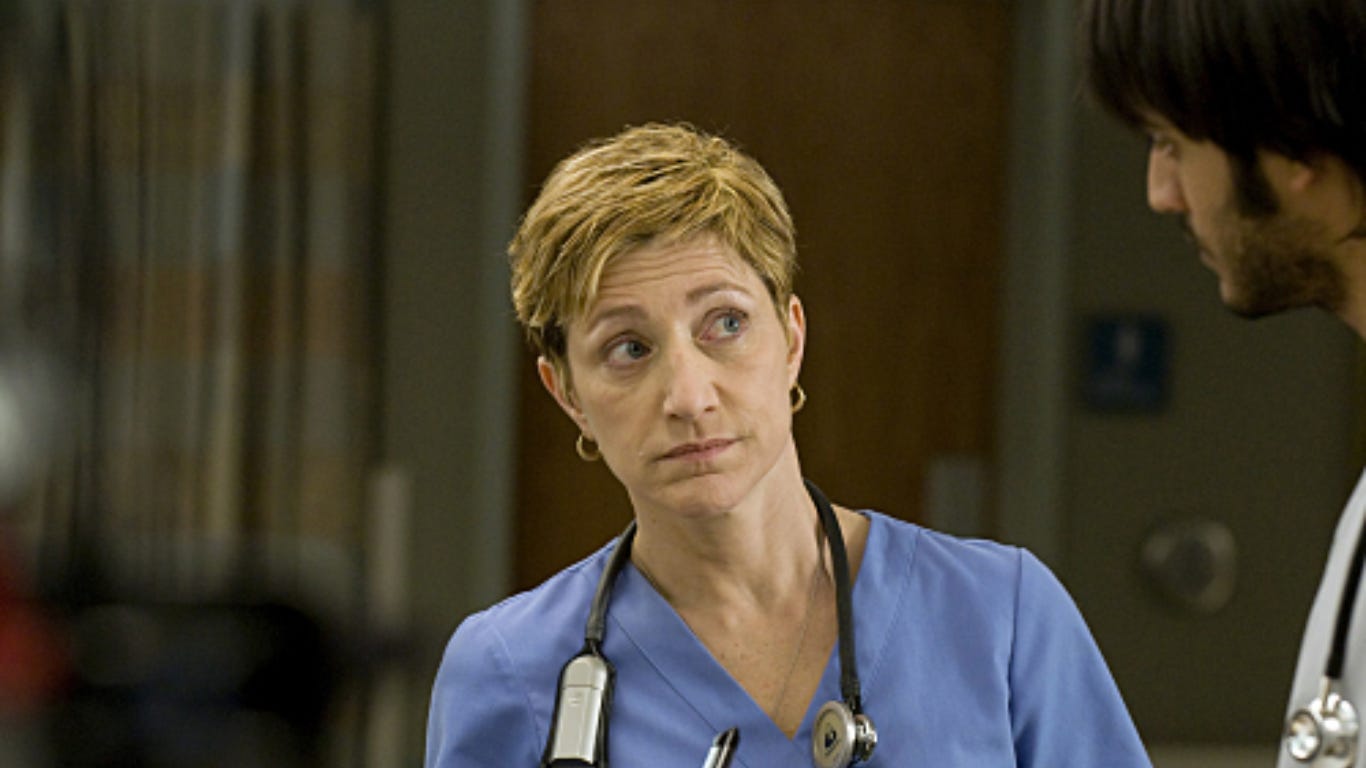
I didn’t watch Nurse Jackie when it first came out in 2009, but I watched the first season when it came to streaming in 2015. A friend was close with someone who worked on the show, and I remember texting her probably only 15 minutes into the pilot episode and asking, “Someone on this show is in recovery, right? This is too accurate not to be written by someone who knows what it’s like.” She told me that, yes, several people associated with the show were in recovery.
As it turns out, that was underselling it a bit. Executive producers and showrunners Linda Wallem and Liz Brixius are both in recovery, as is the show’s star, Edie Falco. Unfortunately for my purposes, Season 1’s realism made it hard to decide which episode to write about; Jackie’s need to use substances drives many of her actions, but she is equally committed to keeping it a secret from everyone in her life. A constant, thrumming tension pulses in the background of each episode, but her substance use isn’t where the action is. She uses quietly and alone before emerging into the acute drama of the hospital and her family life—both made more stressful because of her hidden addiction.
Paid subscribers keep AASL afloat and keep the newsletter accessible to those who can’t afford to upgrade. If you can swing $5/month or $50 a year, please consider becoming a paid subscriber.
I’m getting slightly ahead of myself. As you may have guessed, the show follows a nurse named Jackie (Edie Falco) who works in the Emergency Department at All Saints’ Hospital in New York City. In the first five minutes of the pilot episode, we learn three crucial facts about Jackie: 1) she misuses opioids, 2) she is an extremely capable nurse, 3) she is entirely comfortable breaking the rules in service of what she thinks is right (for example, we see her forge a donor ID card so one of her recently deceased patients can save some lives). Later in the episode, we learn she has a husband and two kids.
That’s all you need to know for our jump forward in time to episode eight (directed by my guy and Making a Scene alum, Steve Buscemi!). The episode opens with a nice little metaphor for what’s happening in Jackie’s life. Walking down the street with her kids and husband, Jackie grabs a tissue to wipe chocolate frosting off of her donut-hoovering daughter’s face.
Jackie is an expert compartmentalizer. She has work in one box, family in another, and her opioid use in a third. As viewers, we know that these aren’t really separate, but she’s doing her best to treat them as such. When she leans over to wipe her daughter’s mouth and pellets from a broken capsule spill onto her daughter’s donut like sprinkles, it’s a not-so-subtle metaphor for what’s happening in her life: her substance use is endangering her family—it’s contaminating the other boxes.
It’s a small but undeniably accurate representation of addiction. When you need a substance so badly that it always has to be within arm’s reach, it will inevitably spill into areas of your life you wanted to protect from its harms. When that happens, the immediate instinct is to go big (throw the donut to the ground) and lie about why.
When she gets to All Saints’, Jackie learns that the hospital administrator (Anna Deavere Smith) has hired a temp nurse for one day to help with the 365-day short-staffing problem. She’s immediately unimpressed, and for good reason—no one’s first interaction with a coworker should be about how they can’t find F8 on a keyboard.
Then, Zoey (Merritt Wever), the effervescent newbie nurse, notices that Temp Nurse Sam (Arjun Gupta) seems a bit...off.
I love the line, “You never narc on a nurse unless you are absolutely sure.” It speaks precisely to Jackie’s mindset: As long as you can do your job and no one knows you’re using, it’s fine. She’s relentlessly committed to nursing and her patients; she’s convinced herself that her opioid use makes her better able to do that job. Sam’s crime is not that he’s misusing substances at work; it’s that he’s doing so in a way that makes him a functionally useless nurse.
The uncomfortable reality is that Jackie isn’t completely wrong. She does have back pain, and opioids alleviate that pain and allow her to do the job she loves. Whether it’s physical or emotional pain, everyone who becomes addicted to a substance does so because at one point in their use, the substance was helping them feel better than they did without it.
The line also speaks to the systemic issues within the healthcare industry. Healthcare workers—especially those working in Emergency Departments—are more likely to have substance use disorders than the general population and often don’t seek help for fear they’ll be fired. Raising a suspicion without proof could needlessly end someone’s career. (There are a bunch of really interesting stats on all facets of substance use disorders in healthcare workers here.)
The Sam storyline concludes with him saying five words that stun Jackie.
What makes this episode so compelling is how firmly it locates the viewers in the cognitive dissonance of addiction. We know Jackie is being a hypocrite. She is misusing opioids at work—she is fundamentally guilty of the same negligence as Sam. But there’s also a very real difference: Jackie, at least thus far, is functioning well at an incredibly demanding job. Sam, on the other hand, acts less like a hospital worker and more like a guy selling merch outside a Phish show. They are objectively not the same.
But in one way, Sam is more aware of what’s going on at the hospital than anyone else—at least when it comes to Jackie. He sees what the pharmacist supplying her habit doesn’t, or what Zoey fails to notice despite nearly walking in on Jackie in the bathroom scene. It doesn’t matter how convincingly she says, “We don’t do that here.” What should be a cliché becomes a bone-chilling truth: Takes one to know one.
She can’t fool him, and that terrifies her. It’s why her face changes the moment he turns away, shifting from the no-nonsense rule enforcer to a terrified-of-being-exposed rule breaker. Sam understands exactly how devastating that exposure would be for Jackie. He knows it the same way I knew that someone involved with the show had their own experience with addiction.
Because sometimes it really does take one to know one.
*
If you enjoyed this post, please like, comment, or share it. This helps others find the newsletter!
Want to show your support of AASL without committing to a paid subscription? Leave a one-time tip here.
Send questions and feedback to askasoberlady@gmail.com. By sending a question, you agree to let me reprint it in the newsletter with your name redacted or changed. Emails may be edited for length or clarity.
I’m not a doctor or mental health professional, so my advice shouldn’t be construed as medical or therapeutic. You are free to take or leave it.
I would add that those of us who have lived with and loved people struggling with AUDs and SUDs similarly learn to compartmentalize and also, because of our hyper vigilance, tend to recognize the signs that someone is using long before others do.
I loved this show. One reason is that it depicts the high-functioning addict. A lot of people who have little knowledge of substance abuse have a stereotype in their mind of how addicts act, how they look, what they do. The truth can be very different.