

I was supposed to go to a book club last Sunday night, but instead found myself pulling my car into an empty strip mall parking lot where all the businesses had closed. It would have been my first time attending the book club, and I was mostly looking forward to it. I’d met the couple hosting it last year, and we’d obliquely stayed in touch on social media. They seemed like good people, and everyone is always telling me to get out more (sigh), so when I saw the Facebook invite to discuss a book I’d already read, not going seemed like I’d be crossing a line from lovingly misanthropic to clinically agoraphobic.
I also wanted to get out of the house, which is unusual for me. For much of the time I’ve lived in rural Washington, I had an old, sick dog with whom I’d rather spend time than any person on the planet. I had plenty of work projects and personal projects, not to mention a partner; I simply didn’t feel like I was missing anything. There was nothing in the small adjacent towns that appealed to me more than being exactly where I was.
Then in August, Sally died. And while I love our new puppy, nothing can replace the connection I had with the sweet little girl I’d spent the last 15 years of my life with—a dog who became as much a part of me as any of my limbs.
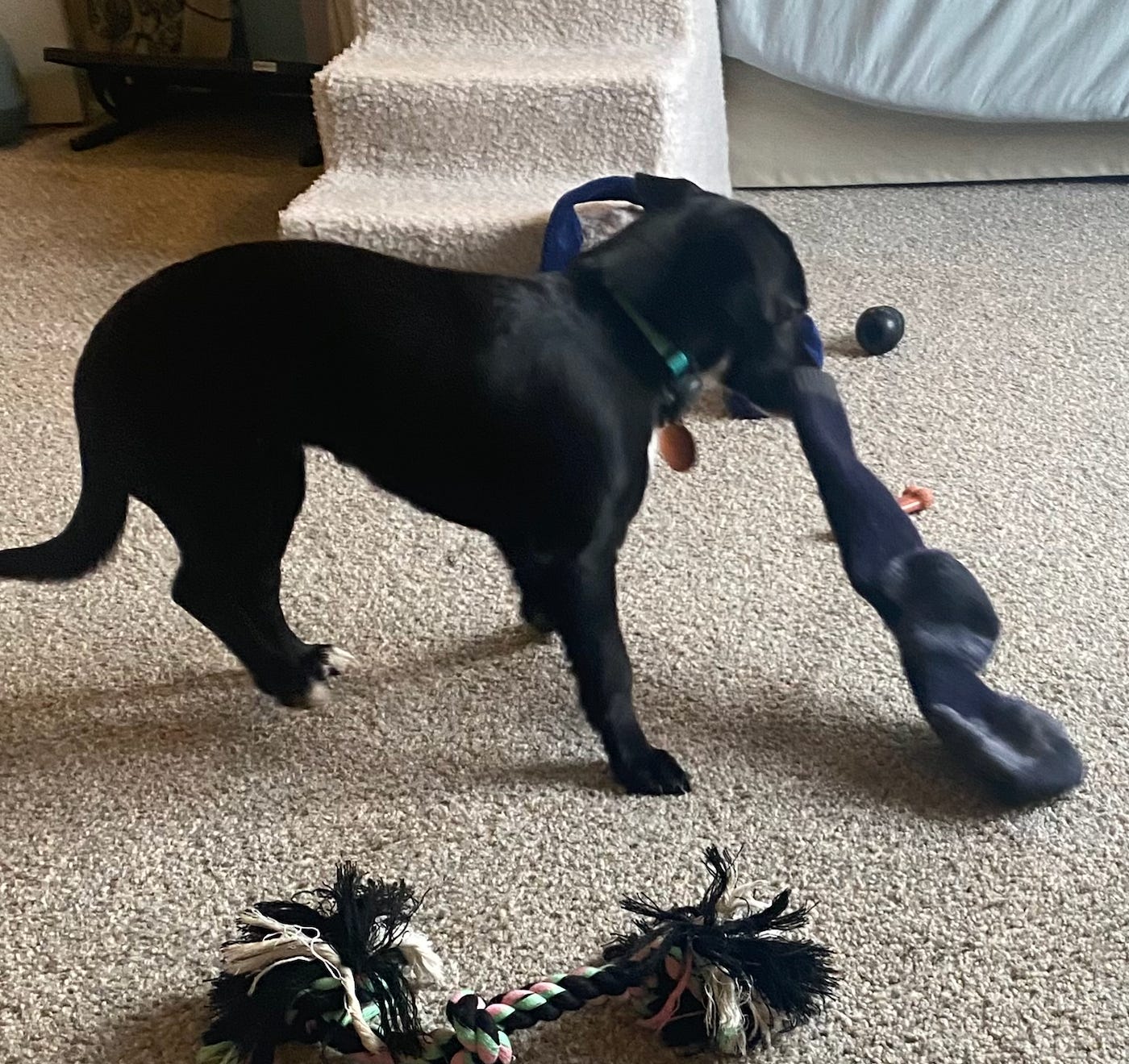
Through fall and winter, I kept plugging away at the projects while doing my best to teach Doris how to pee outside and not eat chapstick and ballpoint pens. My days were filled with writing and rewriting in hopes of getting a project off the ground while at the same time trying to steal my laundry back from a dog whose favorite game is bet you can’t catch me before I eat this sock!
But it looks like that project—the one I spent years working on—may not have a future. And that defeat has seeped into all my thoughts. I feel like a failure. I’m sad. I miss Sally. (And that’s just my bullshit. Toss the state of the world into anyone’s psyche, and frankly, I think we all deserve participation trophies for getting out of bed in the morning.)
I started to feel something I hadn’t in a long time. It wasn’t the urge to drink, but it felt very similar to how I felt at the end of my alcohol use. My internal world felt claustrophobic and catastrophic—smothered by anxious thoughts and spiraling fears, all of which shouted over each other with ever-worsening doomsday scenarios.
This was not a brain I wanted to bring to a book club.
I sat in the parking lot and thought. Should I slap on a smile and tough out the meeting? Should I go home and curl up on the couch? I didn’t feel like I was in acute crisis—this was not a job for my therapist or psychiatrist or any individual—but I needed to do something.
If I had been tempted to drink, I probably would have hustled to an AA meeting. Despite not having attended one in years, I am certain that telling literally any group of self-identified alcoholics that I have 18 years sober and wanted to pick up a drink would result in a torrent of sharing hard-earned experience and annoying-but-useful slogans. I am equally certain that it would effectively talk me out of drinking. But that’s not what I needed.
I wanted something that would help me deal with life as someone who is fairly settled in her sobriety, but is constantly working on the “recovery” part. Something that could help me shift my perspective. More than anything, I wanted to be with a group of strangers who openly talked about how not okay they were.
And then I remembered Melissa Petro talking about secular Buddhist recovery groups and a friend mentioning a nearby Recovery Dharma meeting she sometimes attends on Sunday evenings. As the grey rain pitter-pattered down my window, I pulled out my phone and searched for the meeting details.
15 minutes later, I was pulling into another empty parking lot. The meeting wasn’t scheduled to start for another 20 minutes. I slid low in my seat, playing on my phone while surreptitiously eyeing the parking lot entrance to see if other people were coming. Please don’t let it be just one other person and me.
I wholeheartedly believe in the power of one-on-one help, be it from a friend, a peer, or a mental health professional. But what I wanted in that moment was to be one among others—strangers with similar problems all just trying to get our heads on straight. I’m not sure where that desire comes from, but I suspect it’s one of the many things AA instilled in me: in times of distress, there’s power in coming together with a group of imperfect strangers.
Once I saw a few people enter the building, I followed suit. All told, there were about 8 of us, and I felt the good kind of nervousness that happens when you finally do a thing you’ve been thinking about for too long. We pulled chairs into a circle and sat down. Thus far, it felt like an AA meeting (minus the aggressive greeters).
After a brief introduction, the facilitator announced that, because it was the week of April Fools, he’d created a Dr. Seuss-inspired version of the usual RD opening script. I inwardly braced myself. The knee-jerk misanthrope inside me immediately assumed it would be camp-counselor cringe.
By the time he finished reading, I was in. The playfulness, flexibility of the idea, and the obvious lack of precious self-seriousness hooked me.
One of the main reasons I hadn’t yet dipped my toe into secular Buddhist groups is because I loathe—and therefore refuse to do—the kind of silent meditation where you close your eyes and listen to your breath until you (if you’re me) have a panic attack. For some reason, I thought that was a big part of these meetings. Turns out, it was a short (maybe 4-minute) guided meditation and totally fine. I can listen to someone talk. I just can’t listen to my brain.
Anyway, I can’t remember if the meditation came before or after the group chat and reading from the book, but I enjoyed it all. After the meeting, I chatted with someone who had also gotten sober through AA and had been looking for something like AA “but for life in general” and found it at RD. In a fun bit of kismet or coincidence, depending on your perspective, we discovered that we both got sober in January of 2008, only one week apart.
I left the meeting feeling not unlike I did in the early days of my AA attendance, comforted by the warmth of a safe place to not be okay; a temporary refuge from the chaos in my head.
So I bought a Recovery Dharma book and added the meeting as a recurring event on my calendar. I’m excited to go back next week. I hadn’t realized how much I missed being part of a group of strangers, but I had. I’d missed—and now realize I needed—the camraderie of trudging together through the sludge of being human, awkwardly stumbling our way toward acceptance.
If you enjoyed this post, please like, comment, or share it. Doing so helps others find the newsletter!
Want to support my work without committing to a paid subscription? Leave a one time tip here.
Send questions and feedback to askasoberlady@gmail.com. By sending a question, you agree to let me reprint it in the newsletter with your name redacted or changed. Emails may be edited for length or clarity.
I’m not a doctor or mental health professional, so my advice shouldn’t be construed as medical or therapeutic. You are free to take or leave it.
Katie, this is such a power post. You’re the 3rd person in a week to mention Recovery Dharma. There are two meetings close to my home. How much more of a nudge do I need!?
This is so important and relatable. Happened to me a couple weeks ago. Ended up hitting an AA meeting. I’ve been sober 15 years. But I love meditation. Whatever works.