

Contains spoilers for the 2012 movie, “Flight.”
Many great actors are terrible at playing drunk people. It’s easy to go over the top when your character loses all inhibition. Sometimes, it feels like actors play inebriated characters the way they think the viewers perceive drunk people, forgetting that even booze-hounds have their own internal logic, even if no one else can identify or understand it.
Of the drunk character roles, one of the hardest to play is a (so-called) functional alcoholic. You know the type—they get up, go to work, and may even successfully drive a car with a Blood Alcohol Content that would body slam the average drinker off their feet and to the floor.
It’s hard to play this role because the actor is usually playing multiple characters. One is charming and fun—if only for the small window during which they’ve gotten their drink timing exactly right. It’s the drunk person’s cruising altitude—flying the perfect amount of buzzed.
By definition, though, cruising altitude is temporary. The other characters the actor must play appear during takeoffs and landings, like the internal battle needed to summon the energy to suit up, defy gravity and the weather gods, and launch a hunk of metal off the ground and up through the clouds. Similarly, the precision and focus needed to descend and land smoothly, something that can be tricky even in the best circumstances. Coming down too quickly or unsteadily can be catastrophic. An actor has to be able to pull off these highs and lows without falling into a caricature of addiction.
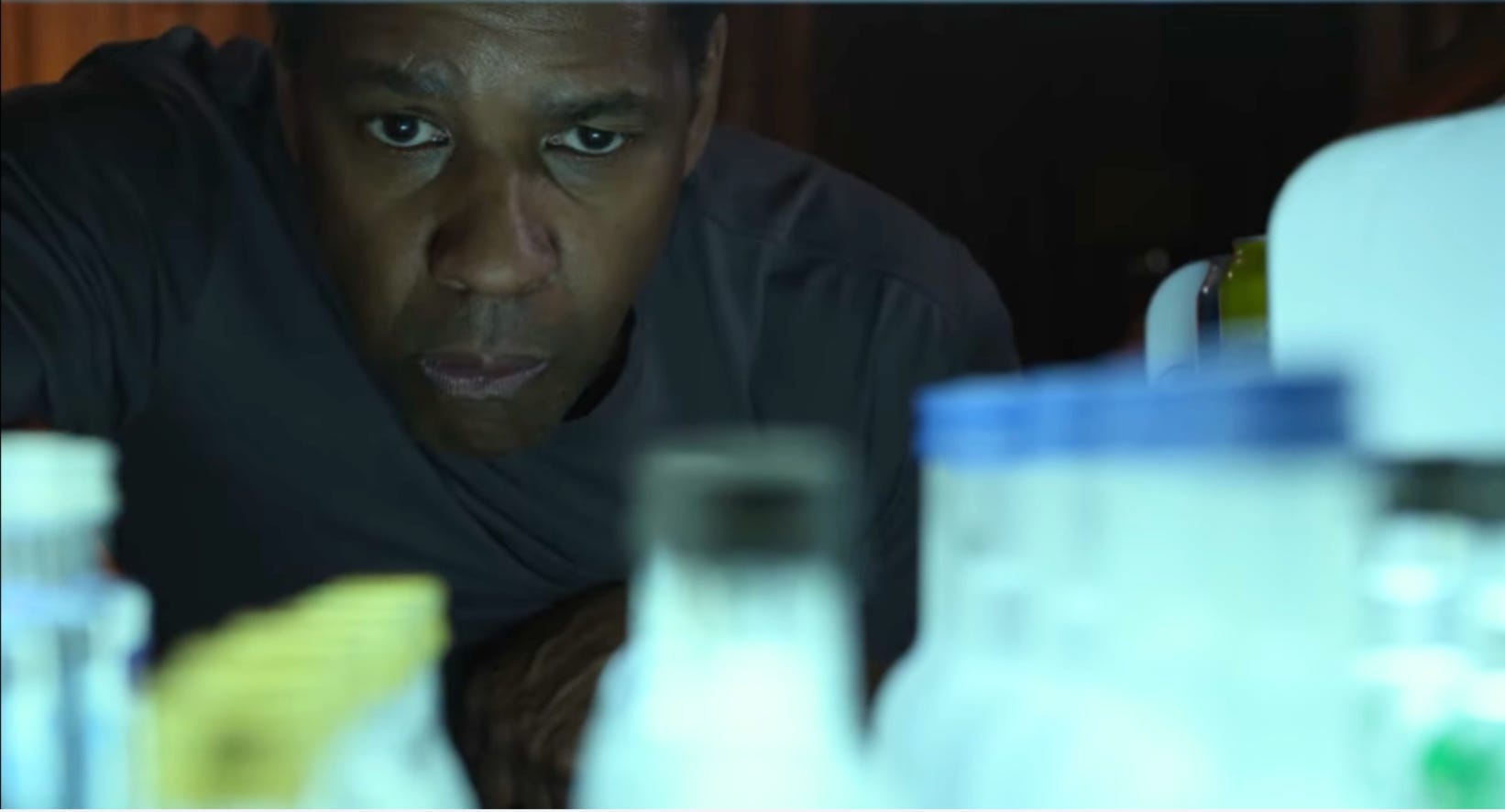
I’ve never seen a better portrayal of this than Denzel Washington in “Flight.” The 2012 film follows “Whip” Whitaker, a pilot and alcoholic used to waking up still drunk—even when his morning consists of piloting a commercial aircraft full of people from Orlando to Atlanta. All he needs is a line or two of cocaine, and Whip is ready for takeoff.
After making it through a harrowing storm and up to cruising altitude, Whip sneaks three airplane bottles of vodka from the beverage cart and dumps them into his orange juice. Downing the juice in just a few gulps, Whip lets his copilot take over and settles in for a nap.
He wakes up to the sound of metal clanging and the airplane rapidly descending. After a horrifying scene of mechanical failure and airplane nosedives (which I admittedly skipped during last night’s rewatch because the first time I saw it, I vowed never to fly again), Whip manages a bunch of fancy (if aeronautically inaccurate) flying moves, avoiding a nosedive into a populated area and instead performing a semi-successful crash landing in an open field.
When he wakes up in the hospital, we immediately learn two things about the crash that will be central to the pilot’s emotional arc:
Six of the 102 people on board died in the accident, including the beautiful flight attendant Katerina, with whom Whitaker spent the previous night.
If any other pilot faced a similar mechanical failure, everyone on board would likely have died. Whitaker’s fancy flying was terrifying, but it saved the lives of almost everyone on board. The consensus, according to the pilot union rep, Charlie (Bruce Greenwood), is “The way [Whitaker] landed that plane was nothing short of a miracle.”
It’s a perfect setup to drive an arrogant, damaged active alcoholic out of his mind. As a pilot, Whip’s job was to get everyone to Atlanta safely, and he failed, losing someone he cared about in the process.
Despite his cocaine use that morning and drinking during the flight, the crash was actually not his fault. There’s no disagreement among the experts that only an exceptionally skilled pilot could have landed the plane with only 6 deaths. He got drunk, and people in his care died, but those people didn’t die because he was drunk. Right?
In the immediate wake of the crash, Whip vows to quit drinking. He hides out at his grandfather’s old farmhouse, where he determinedly pours out all the alcohol he can find. When he arrives for a meeting with Charlie and the union lawyer, Hugh (Don Cheadle), the pilot is more sober than we’ve seen him at any point during the first 50 minutes of the movie.
Hugh tells Whip that the National Transportation Safety Board (NTSB) will be running the investigation into the crash, and its team collected blood, skin, and hair samples from everyone on board. The toxicology report from the hospital shows that Whip was piloting the plane with cocaine in his system and a .24 BAC.
Ah, Whip Whitaker. Welcome to the club of trying to lie your way out of a while-you-were-sleeping blood test. He tells Hugh that his .24 must have been because “he had a couple of beers the night before,” and it’s a little like watching my tiny dog trying to carry a stick that’s 5 times longer than her entire body. It’s so absurd that you don’t even wonder if it’s going to work, but you can’t help but admire the delusion necessary to think it’s possible.

Hugh obviously doesn’t buy this, but also doesn’t care. He promises to get the toxicology report excluded from the investigation. But Whip now knows there’s concrete evidence of his substance use during the flight. He ends his self-imposed sobriety before he’s even left the building. Thus begins a bender, complete with a new girlfriend who is just starting AA and unsuccessfully pleads with Whip to join her.
Charlie and Hugh, having successfully gotten the toxicology report kicked, are determined to get Whip through the hearing without being obviously drunk. By this point, it’s become clear that the pilots’ union and the airline are solely concerned with getting Whip through the hearing successfully so they can shift the blame onto the plane manufacturer.
The viewers (at least this viewer) can’t help but want that too, if only because Washington’s portrayal of Whip is so sympathetic and raw, without ever dipping into melodrama. All of the tormented personalities inside Whip Whitaker are visible in every stare, every sip, every bottle tossed into the trash. For those who don’t know what it’s like to care about someone with an alcohol addiction despite the terrible things they’ve said and done, this film will make you understand.
The only way Whip can stay sober in the week leading up to the hearing is by staying in Charlie’s house. The day before the hearing, he truthfully tells Hugh that he’s been sober for nine days, two hours, and 26 minutes, “but who’s counting?” All Whip has to do is get through one more night and the next day’s hearing without drinking, and all will be well.
Charlie and Hugh think they’ve covered every base: Whip will be staying in a hotel room all night with a person guarding the door. They’ve emptied the minibar of booze and filled it with apple juice and other disappointments. Whip doesn’t have access to alcohol, and without access to his vice, there’s no reason he can’t make it through the hearing and get everyone—himself included—off the hook.
That night, Whip is bored, anxious, and thirsty. When he hears an odd noise, he investigates and realizes the deadbolt to the adjoining room isn’t locked—and it appears to be empty.
The scene is more devastating than if we watched every minute of the bender we know is coming next. By this point, the film has made abundantly clear that for Whip Whitaker, there is no such thing as one drink. We don’t need to see the chaos that ensued because we’ve been watching it for nearly two hours.
I remember watching this when it came out in theaters. Despite being four years sober and well-versed in how addiction works, I couldn’t help thinking the same thing my family and friends had wondered about me only a few years prior: why can’t he just stop?
The next morning, Hugh and Charlie find both hotel rooms in chaos and Whip bloody on the floor of the bathroom, having fallen at some point in the evening and hit his head. This, too, is a brutally accurate emotional leap: how many times have loved ones (or even “cravenly invested in one’s well-being” ones) gone from furious to terrified in the blink of an eye?
The people in our lives who are addicted to substances can be the source of so much disappointment and anger that we lose sight of how serious the condition is. But there’s the reminder—the blood on the toilet seat and bathroom floor, the head wound that won’t stop bleeding.
And that’s a best-case scenario.
Washington’s performance never allows you to forget that for drinkers like Whip Whitaker, substance use—and hiding one’s substance use—is a 24/7, life-or-death endeavor. When his co-pilot gives Whip a knowing look and asks how he's feeling, Washington flashes his charming smile and gives a carefree wave of the hand, while his eyes flash with panic and fury.
In Whip’s world, there are no innocent questions, and self-preservation is a full-time job. He’s always ready for a battle or a party, but never self-reflection or the truth. He manages to bring you inside his turbulent emotions, making you an unwitting co-conspirator. You can’t really root against him because, however reluctantly, you understand him. He is an extreme example of alcohol addiction, but, like all of us, he is also fundamentally flawed and human.
It’s this humanity that ultimately allows Whip to face the truth about himself. When he finally makes it to the hearing, once again drunk from the night before and functioning only with the help of a massive amount of cocaine, Whip is so close to getting off scot-free.
All he has to do is tell the assembled panel that Katerina is responsible for the empty vodka bottles in the airplane galley trash. High, bandaged, and sweaty, Whip’s moment of clarity comes not from losing his wife and kid, or the plane crash, or Katerina’s funeral. It comes when he stops lying. When he admits that he drank those bottles, that he was drunk that morning, and he’s drunk right now. It comes—as it does for all of us—when he stops running from reality and turns around and faces it head-on, regardless of the consequences.
*
If you enjoyed this post, please like, comment, or share it. Doing so helps others find the newsletter!
Want to support my work without committing to a paid subscription? Leave a one-time tip here.
Send questions and feedback to askasoberlady@gmail.com. By sending a question, you agree to let me reprint it in the newsletter with your name redacted or changed. Emails may be edited for length or clarity.
I’m not a doctor or mental health professional, so my advice shouldn’t be construed as medical or therapeutic. You are free to take or leave it.
I also saw the movie. I'm in recovery (05/24/09) and that scene in the hotel room is bone chilling! Denzel pulls it off so realistically that he either has struggled with addiction or had someone coach him on how to portray it. Anyone who's been addicted KNOWS that when he finds the stash of alcohol there is NO WAY he's NOT going to drink it all! I had 3 years sober when I saw the movie. I truly never understood until I got sober that one IS too many and a thousand is never enough. I used the same knowledge to finally quit smoking after trying to quit for 30 years! I just watched the scene again and had the same reaction: complete terror! Thank you for sharing.
Ouch. This one’s close to the bone - because it was the film the counsellors in rehab made us watch. I’m not sure I could watch it again even 12 years on.