

All AASL posts are free, but paid subscriptions keep the newsletter alive. If you’re able, please consider upgrading your subscription.
After writing about Elizabeth Gilbert’s new memoir, I received a bunch of comments and DMs along the lines of “See! This is exactly why I hate memoir and self-help!” That’s an entirely valid, understandable opinion, but it’s not mine.
Generally, I like recovery memoirs. In particular, Caroline Knapp’s Drinking: A Love Story cracked my heart open in a way few books—recovery-related or otherwise—ever have. It’s gorgeously written, and I have never read a better articulation of the thing that nearly destroyed us both.
For me, that’s the power of storytelling in recovery. Discovering how other people clawed their way out of addiction, what worked, what didn’t, and where my experience overlapped with others helped me feel like a human among other humans, as opposed to a monster all by my lonesome.
When done well, a memoir in this genre (I hate the term “quit lit”) cuts through the substance or behavior that fuels a person’s addiction and reveals a messy core of longing, vulnerability, pain, anesthetization, and discovery. It can be thrilling and, in the best of circumstances, revelatory.
Self-help books are a different beast. I’m a stickler for detail, nuance, and well-sourced evidence. I want to know that I have a good reason to trust the author—ideally through a combination of their personal and professional experience. Maybe it’s just the science journalist in me, but I can be picky and pedantic; none of the self-help books I’ve tried in the past made much of an impact.
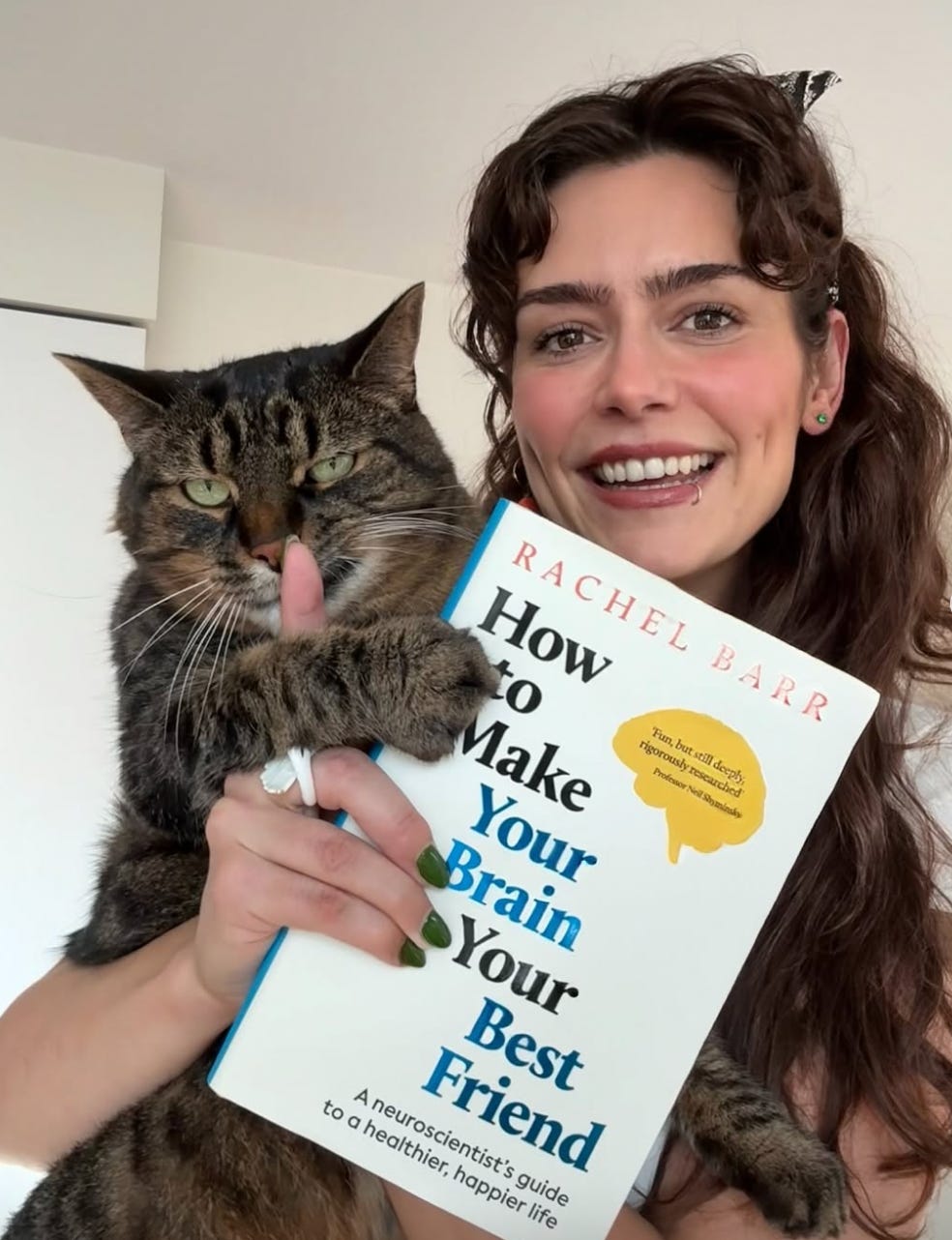
Before I finished the first chapter of Rachel Barr’s How to Make Your Brain Your Best Friend, I knew this book was different. It’s a masterclass in how to avoid the traps of the genre: it’s entirely free from generalizations, reductive characterizations, inaccuracies, and unsupported claims. I am in awe of what Barr accomplishes—I genuinely didn’t know self-help could be done this well.
I never would have picked it up based solely on the title; I’m judgmental, picky, and familiar enough with my brain to feel confident that “best friend” is never going to be an accurate descriptor of our relationship. The subtitle, A Neuroscientist’s Guide to a Happier, Healthier Life, seemed to promise what most self-help books promise but few deliver. Fortunately, someone smarter than I am recommended it to me, and I’m so glad they did.
Rachel Barr is indeed a neuroscientist and, it turns out, an excellent writer. I started to fall in love with this book on the second page of the preface, where Barr tackles the hype around the wellness “optimization” craze.
She writes, “There’s a lot of money to be made convincing you that suffering stems from not optimizing every inch of your life,” and proceeds to outline why such big, flashy changes often offer very little in the way of meaningful, lasting mental health improvements.
Barr explains that she “can’t help you optimize your way to perpetual happiness,” but she can “teach you how to take better care of your brain so that perhaps, in turn, it’ll take better care of you.”
Self-help rooted in science is challenging for any writer. What many people want from self-help books is something that responsible science writing cannot provide: grandiose promises that are universally applicable to all scenarios and readers. That’s why good science journalism is full of irritating and clunky phrases like “research suggests,” “may indicate,” and “increased/decreased likelihood.”
Barr navigates these landmines with enviable ease and a healthy dose of compassion.
“[The] intrinsic ambiguity of science leaves a space wide open for charlatans and snake oil salesmen to swoop in with flashy but baseless promises...In other words, ‘become the person you’ve always wanted to be, easily and with guaranteed success,” she writes. “Often, these snake oil solutions are marketed to us under the guise of science, particularly online. Falling for it doesn’t mean you’re naive; it just means you have a normal, functioning human brain, built to make sense of the world using shortcuts and associations.”
Instead of glossing over the reality that nothing will apply to everyone, Barr empowers the reader to be curious about the information she imparts and how it may or may not be useful for them.
She advises the reader that, “Applying neuroscience to personal growth involves experimentation, adapting or discarding suggestions when they prove unsuitable for your needs...Keep track of your experiences as you go along, noting what works and what doesn’t. This iterative process helps you refine your approach based on real-world feedback, bridging the gap between general scientific principles and personal fit.”
If I wasn’t sold on Barr’s approach by the time I got to those words (and I definitely was), what came next seemed almost eerily perfect for me.
She writes, “This nuance is vital: even well-supported research findings aren’t always universally applicable. It’s fairly well established that meditation can help reduce stress, for example. Yet in some rare cases, it can trigger panic and distress.” (ME! THAT’S ME!!) “What works wonders for many might not be quite right for you, which highlights the inherent precarity of applying generalized advice.”
**Chef’s kiss** Perfection.
If you’re interested in the mysterious inner workings of your brain, how it shapes your thoughts and behaviors, and how to play nice with it, I highly recommend How to Make Your Brain Your Best Friend. Beyond the book recommendation, however, I appreciate Barr’s approach to this endlessly complex subject. Apparently, it is possible for self-help to be nuanced, compassionate, informative, and—as an added treat—very funny.
I don’t know if my brain will ever be my best friend, but thanks to Barr, I might be able to make it a cordial acquaintance.
If you enjoyed this post, please like, comment, or share it. Doing so helps others find the newsletter!
Send questions and feedback to askasoberlady@gmail.com. By sending a question, you agree to let me reprint it in the newsletter with your name redacted or changed. Emails may be edited for length or clarity.
I’m not a doctor or mental health professional, so my advice shouldn’t be construed as medical or therapeutic. You are free to take or leave it.
I’m so sorry; I didn’t mean to lock the comments to all but paid subscribers! If that ever happens again, let me know ASAP because that’s never the plan (unless things get really wild and unproductive in the comments but, fingers crossed, that hasn’t happened yet!).
I ordered this book! I'm very interested in neuroscience and I trust your judgement because, well, I do. My brain has always treated me like the uncool and desperate 6th grader in the cafeteria and I'm always been cynical about self-help and parenting books, mostly because they seem to say (at least to me): "well here's what you should have done, but now live with your terrible mistakes and buy this $85 candle and see if the crying stops." Thanks for the recommendation :)