

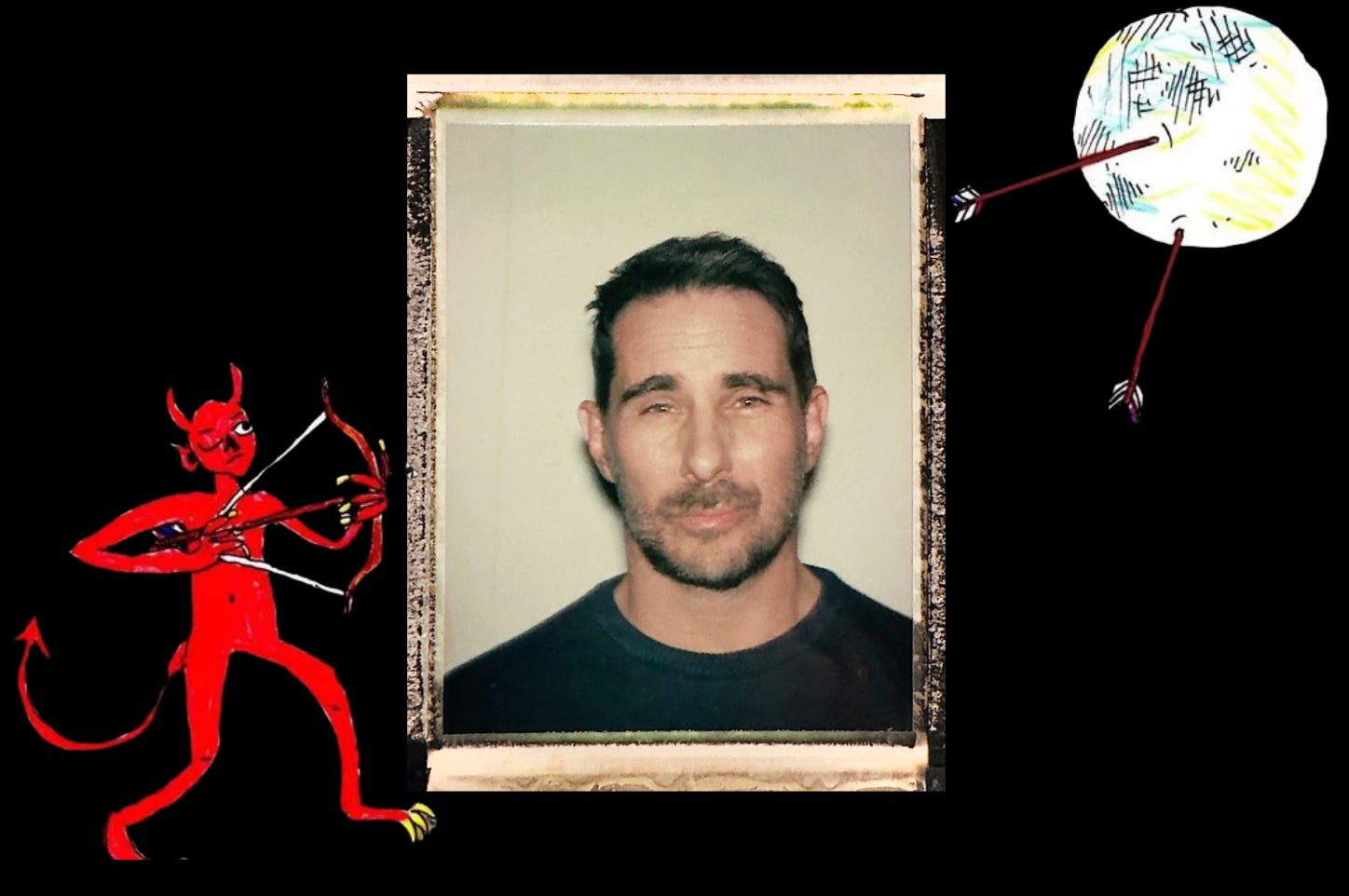
A.J. Daulerio is a writer, editor, and founder of The Small Bow, an excellent publication about recovery. I reached out to A.J. in 2019 with an essay idea, and he pushed me to make it much better than my original concept. So much so that it earned a “Notable Essay” mention in 2020’s Best American Essay collection. He and I have spent a lot of time talking about recovery, but I hadn’t heard his whole story, so this was really fun for me, and I hope it is for you, too.
He’s also the former editor of Gawker and Deadspin, so his brief mention of the “Hogan trial” refers to Hogan’s lawsuit against Gawker—you can read some of A.J.’s reflections on all that here.
Katie: Thanks for doing this, A.J. So, general question first: how did you find your way to recovery?
A.J. Daulerio: What are we defining as recovery?
KM: Ok, let’s back up. When did you start using substances, and how did your use spiral to a point where you needed to do something about it?
AJD: I went to outpatient treatment when I was 18 or 19 years old; it was my freshman year of college. Really, I was clinically depressed, but I didn’t have the language or capacity to explain that, so I kind of faked alcoholism because I thought that was sexier. I went to a couple of [12-step] meetings and realized that I may not need it now, but I’ll be back here at some point in the future.
KM: Really?
AJD: Yeah, I had a sneaking suspicion that it was on my path of destiny.
KM: I get that.
AJD: I was about 25 when I got to New York, and that’s when I started to do really heavy drugs. I started [using] coke and was really struggling, always running into trouble because of it. I decided to go to treatment, not follow through with treatment, and then switch to drinking or smoking pot or whatever.
By this time, I was in my 30s, and it was really apparent to anyone who knew me that I was a drug guy. I mean, that was definitely part of my personality, and a personality I enjoyed. I had the mindset that as long as I was open about my drug use, I couldn’t have a problem because I’m not hiding anything...and therefore I’m just a recreational user, party guy, and there are no issues.
KM: And how’d that work out?
AJD: Obviously, there were issues. All of my relationships, my hygiene, and my overall approach to the world—everything was altered by that point. I tried to get clean on my own a few times. I remember I got six whole days without going to a bar, which was great. But that’s also when I knew—like, man, this isn’t happening on my watch.
KM: Did you go to treatment then?
AJD: In August of 2015, I tried inpatient treatment in Jersey; I lasted nine days. I thought I was fixed and that my problem was just pills, and when I got back to New York, I immediately started to dabble again. By October, I was on my ass.
I went to [a rehab in] Florida for a couple of months to get super clean, and that stuck for the most part. I had a little bit of a relapse in April 2016, when I was mired in the Hogan trial thing. But I took my first day back chip on July 15th, 2016. It’s been over 10 years now.
Paid subscriptions are the best way to keep AASL afloat, support my work, and ensure the newsletter is accessible to anyone who can’t afford to upgrade. If you can swing $5/month or $50 a year, please consider a paid subscription.
KM: Did the rehab in Florida operate using a twelve-step model and, if so, did you struggle with that at all?
AJD: My treatment center booked itself as a holistic place—I still want to know what that means. I think we did a sound bath once and had acupuncture, but it was kind of janky. And yeah, they took us to 12-step meetings, and I didn’t take to it right away. It wasn’t even the God stuff; it was more my attitude. I acted like I was there on some sort of probationary period, like I’d go here for three months and then do something cooler.
KM: What changed?
AJD: As soon as I started finding people I liked in those rooms, it started to make a lot more sense to me, and I’ve been a 12-step person ever since. I mean, I find a lot more of what I’m looking for in terms of emotional sobriety in the adult child [of alcoholics] rooms, but I go to AA for other people. I go there to support other people, you know, and recertify and raise my hand, and say I’m an alcoholic. I think that’s important.
KM: How do you define recovery? Because for me, there’s a real distinction between sobriety and recovery.
AJD: Oh, for sure. I usually think of it as there’s abstinence, there’s sobriety, and there’s recovery. Abstinence is just people who no longer drink, right? People who don’t actually need some spiritual part of their life in order to maintain that abstinence. Sobriety is where I think of bringing in the spiritual element; for me, that comes with a 12-step program. And then recovery is everything that requires me to stay sober and sane. 12-step is just one part of that. I work through depression as part of recovery. I’m recovering from mental health issues and mood disorders, and sobriety helps me with those disorders.
KM: That’s similar to how I think about it. The sobriety part is not putting alcohol into my body, knowing why I can’t, and what I need to do to ensure that I don’t. Recovery is the ongoing process of untangling all of my mental health stuff, substance use stuff, trauma stuff so I can move forward without getting stuck in the muck.
AJD: There’s no growth with me without doing all that. Before, I was winging it. But it takes a lot of discipline and consistency on my part to stay upright. I know I need all that stuff. I feel it when it’s not there.
KM: How did The Small Bow come to be?
AJD: I was looking for stuff to read [about recovery] when I first got out of treatment. I’m kind of a magazine dork. And as someone who has worked in [media] for a long time, and always admired long features, I was searching for good writing. I would Google stuff, and [the results] would be websites for rehabs. And also a lot of listicles and that sort of shit. A friend directed me to Clancy Martin’s Harper’s story, and when I first read it, I was willing to give Harper’s all my money to put that story out in the world; I know that really helped me. I was like, oh, I want to create someplace where I can have more of this writing.
KM: No listicles, no cheesy hope.
AJD: I didn’t want hope at that point. I wanted comfort. That’s what I thought The Small Bow (TSB) should be. Comfort more than anything. I know I’m not cured, and I will never be cured. Like, remember when we first started working together? That essay you did? That essay was not necessarily a recovery essay. It was a “this is what I’m still dealing with” essay.
KM: Definitely.
AJD: That’s the stuff I think is more important; that’s worth putting out there. People should know they don’t have to feel bad if they are not completely changed by a Higher Power or whatever. So, yeah, that was the impetus for it. It’ll be nine years this month, which is crazy.
I mean, you’re a writer, and you write for a living, and you write about yourself. It’s natural to want to write about what’s going on in your life, and it would feel strange to not share that.
KM: I agree, though I’m not really making a living. But, how do you maintain your recovery now? Do you sponsor people? What does recovery maintenance look like for you?
AJD: I try to sponsor people. I raise my hand all the time. I get rejected constantly. My sponsor told me to sit in the front row and share about my insecurity about not being able to sponsor people. I did, and still nobody fucking wants me to be the sponsor.
But yeah, I go to three to four meetings a week. I do The Small Bow meetings. I meditate, pray, journal; I do a lot.
KM: Where do you see TSB going in the future? Do you see yourself doing this for a long time? Do you have other goals or aspirations that aren’t related to recovery?
AJD: Career-wise, you mean?
KM: Yeah.
AJD: No. I do the podcast; we’ve got this book coming out—I’d like to do more books. But recovery still feels like it’s such a huge part of my life; I don’t feel the need to go anywhere else right now. I do want The Small Bow to get to a point where I’m overseeing it more than I’m writing it. I’d like it to be probably 25% me as opposed to 60 to 70%, which it is now.
KM: Do you ever feel like you have to portray a certain image or experience of recovery?
AJD: There’s a part of me that does feel that pressure. So I try to be very, very open about my bad days. But it’s equally important to talk about getting through those bad days and coming out on the other side. That may sound fucking corny to everybody who’s reading it, but, you know, whatever. I try to put that out there too, even though it makes me more uncomfortable than all the dark shit. Explaining to people that I’m happy and grateful is tougher for me than saying ‘I want to drown myself in a toilet.’ But I know that’s part of the work of recovery too.
KM: It is.
AJD: I think my mood disorder is really the best way of pathologizing what my problem is. It’s something that I’ve struggled with since I was six. Dealing with that daily is hard. I know I’m still an asshole sometimes. I’ve had moments in sobriety where I think I’ve been gross in my interactions with people and how I’ve treated others. But I can also see, like, okay, this doesn’t happen as frequently as it did before.
KM: Also, being able to identify those moments as gross or fucked up or whatever is something I couldn’t do before. I was in my own little fucked up world all the time, and collateral damage was not my problem.
AJD: I always say it’s like being in a parking lot, bumping into all the cars and then driving away, and convincing yourself, ‘well, they all parked like assholes.’ Now I at least try to go back and put a note on people’s cars.
*
If you enjoyed this post, please like, comment, or share it. This helps others find the newsletter!
Want to show your support of AASL without committing to a paid subscription? Leave a one-time tip here.
Send questions and feedback to askasoberlady@gmail.com. By sending a question, you agree to let me reprint it in the newsletter with your name redacted or changed. Emails may be edited for length or clarity.
I’m not a doctor or mental health professional, so my advice shouldn’t be construed as medical or therapeutic. You are free to take or leave it.
Thanks for this interview. I’m a big fan of A.J. since the Gawker and Black Table days. Both of you do so much good work in dignifying sobriety as a path toward a gentler life.
That last line. Priceless!!