

Today is my birthday! I am not a big birthday person, but I am shameless about finding excuses to promote the newsletter. So if you’d like to do something nice for me today, please consider upgrading to a paid subscription or sharing the newsletter with someone who might be interested in it.
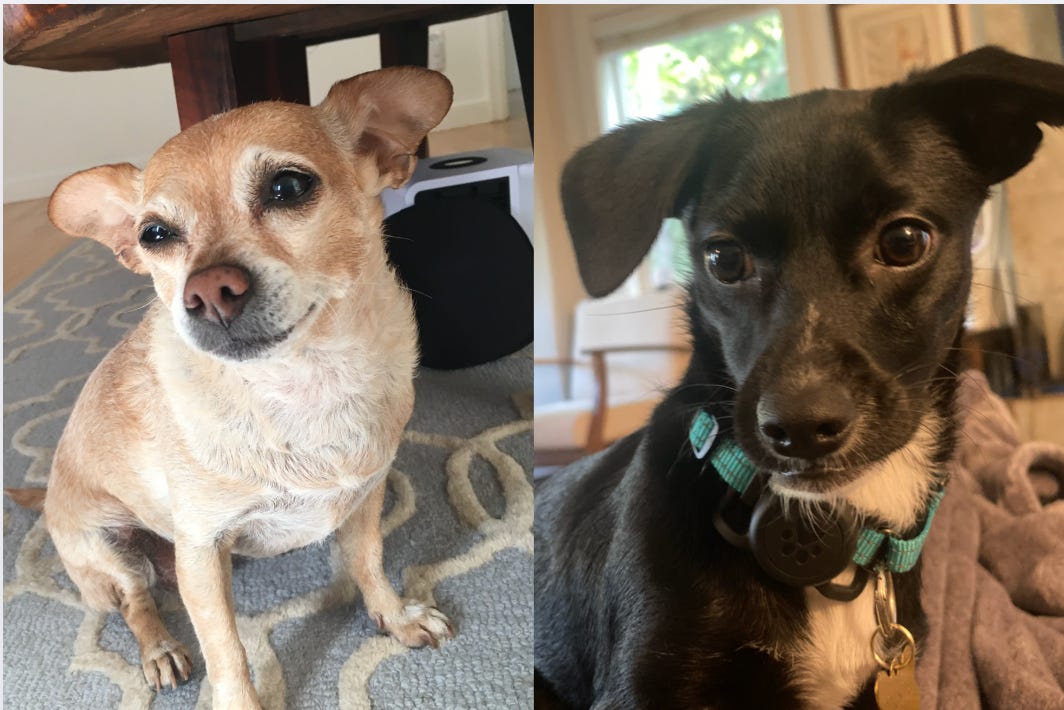
The timing of Sally’s death was a brutal blessing. My partner and I had driven to Tahoe, where we were going to spend a few days alone before being joined by my parents, sister, brother-in-law, and two adorable nieces.
Technically speaking, this all still happened—just not the way anyone envisioned. Our “alone time” quickly became a surreal nightmare. Sally got sicker and sicker, and we euthanized her the day before my family arrived.
We debated whether we should stay or drive back to Washington. Everyone else was ready for a fun family vacation, and we were grief-stricken bummers. But I love my nieces and don’t get to see them enough—it was hard to see the point of driving back just to be even more miserable at home. So we stayed.
It was a great decision. The week was still marked by intense grief, but surprisingly— considering our feelings—a fair amount of joy. In particular, my youngest niece spent the days climbing on me, cuddling with me, and begging me to play with her. This smart, needy, goofy, loving, temperamental girl wanted all of my attention almost all of the time.
I joked that she was like “Sally methadone.” I was still wracked with grief, but my experience of that darkness was so much less crushing and debilitating than it would have been if I were home alone. Distraction, comfort, and extreme cuteness temporarily filled some of the pieces of my utterly broken heart.
About a month after Sally passed, I applied to adopt a dog. Several people close to me questioned the wisdom of this choice. Was I really giving myself enough time to grieve? Was I going to try to turn this dog into a Sally replacement? Put simply, they worried I was trying to fill a bottomless hole.
They were valid questions—ones I’d thought about myself. I thought about the clichéd archetype of an “addict,” so avoidant of pain and discomfort that the moment one addiction is taken away, they immediately find something to replace it. I instinctively wondered if my desire for another dog on the heels of losing Sally was some kind of unhealthy, avoidant, “addict-y” thinking.
Very quickly, I realized that I’d fallen into the same trap many of us do in this era of wellness crazes, ubiquitous therapy-speak, and diagnosing oneself via random TikTok videos. I’d pathologized something that was actually...pretty normal.
I live in a rural area and work from home. I never felt lonely spending my days alone in the house because I always had my best friend by my side. Adopting a new dog wasn’t an effort to replace Sally. Who could understand how irreplaceable she was more than I could? I was trying to fill the emptiness of the house, to find a little creature to chew on bones or nap at my feet while I click-clacked away at the computer. A buddy with a small bladder who could remind me to take breaks and get outside, and who might snuggle with me after a hard day.
What would have been the point of denying that instinct? Would anyone be better served if I spent more days alone in the house, feeling the acuteness of Sally’s absence? Would anyone be harmed if I didn’t?
Among some in recovery, there’s a tendency to view anything that offers immediate gratification or relief from pain as inherently risky. It’s an understandable instinct; the quest for (or inability to resist) immediate gratification is often part of why people misuse substances. And I do not doubt that there are cases of so-called “replacement” addictions. Recovery is a messy, non-linear business. But it’s dangerous to assume that all such efforts are unhealthy or in some way problematic.
It’s the same mentality that causes people to ooze disapproval when they encounter someone who is using medication (naltrexone, methadone, etc.) to assist their recovery. Too often, people act like the only “real” way to recover is also the most painful. But recovering from a substance use disorder is too important for these kind of pissing contests.
Our new dog, Doris Day, arrived on September 13th. She is six months old and wildly different than Sally. Sally was startled by anything that moved too quickly—Doris would like to chase and possibly eat all of those same things. Going to the vet caused Sally to vibrate with fear; when the vet tech sat down to introduce herself to Doris, Doris promptly crawled into her lap and fell asleep.
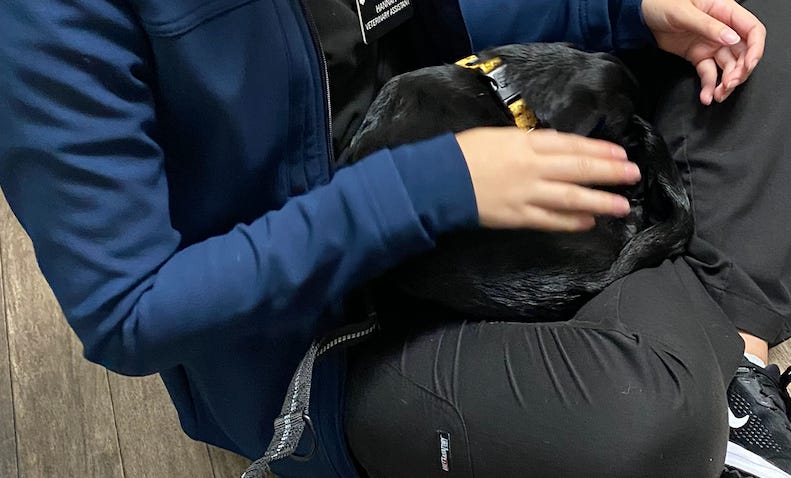
Contrary to being a “replacement,” Doris is so different from Sally that it makes the latter’s absence all the more glaring. Sometimes when she looks at me with her big, dark eyes, I’m overwhelmed by the not-Sallyness of her. It seems incredible that I can love this dog so much after just a few weeks, all the while missing Sally with every bone in my body.
If Doris were simply a smaller, longer, and darker version of Sally, it would be surreal and upsetting. Sally was who she was because of the way life happened to her, and the same was true for me. Our relationship developed as we helped each other out of our respective PTSD-laden bogs. It was unlike anything I’d ever experienced; knowing that nothing can replace it is both beautiful and gutting.
It’s okay to take the less painful road. It’s good to look for comfort in dark times. We don’t have to chalk every desire and emotion up to a condition in the DSM or overanalyze why we want what we want. I’m a person who’s happier with a dog. It doesn’t have to be any more complex than that. Losing a dog is a hard thing. Getting sober is a hard thing. If you find something that helps, embrace it and be proud of it. In the dystopian darkness of the world, we can all use as much hope and happiness as we can get.
If you enjoyed this post, please like, comment, or share it. Doing so helps others find the newsletter!
Send questions and feedback to askasoberlady@gmail.com. By sending a question, you agree to let me reprint it in the newsletter with your name redacted or changed. Emails may be edited for length or clarity.
I’m not a doctor or mental health professional, so my advice shouldn’t be construed as medical or therapeutic. You are free to take or leave it.
Hard relate! I made the choice to adopt a new pup very soon after my soul pug (Mia) passed. As a sober human, I gutchecked my motives and knew that my yearning was from a place of love not distraction. I made the right choice!! The coziest homes are those with lil furbos running round.
I replaced an unhealthy relationship with food with a book addiction. Some days, I feel bad about it, but other days, I’m like, hey, this is ultimately better for my life than my previous habit, so I’ll take it.
I don’t think getting a new dog even really falls into the same category because caring for a living being is very different than a solo habit, but even if it did, I don’t know why anyone would judge since your life is clearly improved by having Doris in your life (and vice versa, I’m sure). I look forward to hopefully seeing more of Doris in this newsletter! Happy birthday, Katie!